Monday, March 11, 2013

Le papier ne sera jamais mort / Paper is not dead !


Adweek (AdFreak) writes:

Paper Is Dead, Except When It's the Most Important Thing in the House

Paper? Pa-per? What the hell is that? Leo Burnett's ad for French toilet-paper brand Trefle celebrates parchment in its various forms, presenting a woman who reads printed books, puts sticky notes on the fridge, plays sudoku with a pencil and draws pictures on a paper pad with her daughter. Her doofus husband prefers doing all such activities on his tablet computer, and he admonishes her time and again for being old fashioned. But he gets his comeuppance while sitting on the can (that's Cannes in French). The toilet paper runs out, and when he calls for a refill, she slides his tablet under the door, its display aglow with the image of fluffy T.P. ("Paper has a big future," says the onscreen text.) I picture the wife in the hall, rolling - for lack of a better pun - on the floor with laughter. So, you can wipe the screen, but shouldn't use the screen to wipe? Wish I'd known that years ago.

Thursday, January 31, 2013

A little village goes global


Not long ago, it was still peaceful in the small Swiss mountain village of Obermutten. This idyllic settlement of a mere eighty residents was known to virtually no one save a few hikers passing through now and then. Now some sixty million people around the world have either read about or heard of Obermutten. Media reports about the village have appeared in over twenty countries. Obermutten even made it into the main news programme in South Korea.

It all began with a newly created village Facebook page. The local mayor made a remarkable promise in the first video posted on the page: Just click on "like", and your profile picture will be posted on the Commune's official notice board. In no time at all, the board was completely covered with fans. In order to deal with the flood of inquiries from fans, it was necessary to resort to hang up the profile pictures on barn walls in the village. In the meantime, the community has increased to over 17'000 fans.

www.facebook.com/obermutten - A campaign dedicated to the little and lovely mountain villages in the Canton of Graubünden, Switzerland.

Tuesday, January 29, 2013

The challenges and opportunities that the evolution of the social network markets brings about to the modern creative industries

Creative industries and social network markets

In order to discuss the challenges and opportunities modern creative industries are facing, let’s first look at the nature and relationship of these industries and social network markets.

According to Hartley, creative industries are among the drivers of demographic, economic and political change. They start from the individual talent of the creative artist and the individual desire and aspiration of the audience. These are the raw materials for innovation, change and emergent culture, scaled up to form new industries and coordinated into global markets based on social networks. /4/

Potts, Cunningham, Hartley and Ormerod propose a new definition of the creative industries in terms of social network markets. The extant definition of the creative industries is based on an industrial classification that proceeds in terms of the creative nature of inputs and the intellectual property nature of outputs. They propose a new market-based definition in terms of the extent to which both demand and supply operate in complex social networks.

The creative industries rely, to a greater extent than other socio-economic activity, on word of mouth, taste, cultures, and popularity, such that individual choices are dominated by information feedback over social networks rather than innate preferences and price signals. Other people’s preferences have commodity status over a social network because novelty by definition carries uncertainty and other people’s choices, therefore, carry information. The creative industries are, to coin a phrase, about the ‘creation of industries’ through social network market dynamics and institutional emergence rather than about creativity in industries, which may often be routine and functionally asocial. /10/

The social network markets sector is composed of systems that build and maintain social networks (e.g., advertising, architecture, media, ICT software, etc.) and also (by definition) systems that create value on these social networks though content (e.g., film, TV, music, fashion, design, etc.). This distinction is certainly not clean; for example, media companies often both create networks and supply content.

Social network markets are an important and rapidly growing part of the world economy. Even though social network marketing is still in its infancy, it holds a potential success for businesses if it is carefully integrated in the marketing mix.

When we talk about social network marketing, it’s important to understand that it’s been around for a while. „There may be some new twists or applications, but it isn’t much different than the days of people meeting in the town square or at the general store, or more recently at a chamber function or conference,” says Scholle. /11/ However, the new technologies make it easier to identify and connect with a wider audience than was available earlier in the social media timeline.

For hundreds of years, expressing yourself and displaying your passion and talents was confined to writing, drawing or painting on a piece of paper and begging a publisher or someone of influence to tell the world, publish or display your work. It took time, money and often access to powerful social and business networks. Television, radio and modern mass media made it easier to be discovered. Yet, in reality it still required money and other people’s networks. Social media and social networks as we know them today have turned this traditional model of influence, attention and self expression on its head. „Social media has touched something in human consciousness that goes beyond just online conversations. It has provided a global connectedness that is culture and nation changing. It has given us as individuals control over our lives and how we express ourselves,“ explains Jeff Bullas. /2/

Facebook dominates the world social media market currently with 61.2% market share. /12/

Opportunities in social network markets

In a Web 2.0 world, we can use social media as a method of shameless self-promotion. Social media have made it easier than ever to catapult from obscurity to prominence. „In recent years, the Web has blossomed into a more egalitarian version of American Idol, where nobodies compete for attention alongside somebodies,“ says Steven Leckart. /6/

The Internet and digital media give us a huge opportunity to get our work out there for the world to see – and buy. Instead of kowtowing to gatekeepers, creative people all over the world can make a direct connection with their audience, grow their fan base and reap the rewards. The democratization of media that is social media, allows everyone to express themselves globally in full colour and rich multimedia.

Used in the right way, social media is a great resource for designers, enabling them to find inspiration, get advice from peers and boost their profile. Today, a teenager posting webcam videos to YouTube can get a movie deal (such as Lucas Cruikshank in „Fred: The Movie“). Bloggers creating Internet memes are being offered book deals. No longer do writers need to beg a book publisher for access. They can now self-publish and place their book in the Amazon or Apple book store.

Thanks to the wonders of social media, nowadays talent scouts are more likely to find the next big thing online than at the mall. While Myspace was once the place to be discovered, video-sharing uber-site YouTube has since taken over as the wannabe pop star’s place to post. As many of you will know, Justin Bieber’s pre-pubescent warblings were spotted by a talent scout Scooter Braun who arranged for Bieber to meet with Usher. The rest is now history – Bieber has become one of the most influential musician of today. Following his footsteps, PSY’s YouTube video Gangnam Style went viral and the K-pop singer was offered a record deal with Scooter Braun.

Social media can also turn already talented and awesome but lesser known artists into overnight sensations. Professional musicians also use YouTube, Myspace, SoundCloud, Facebook and other social networks as a free publisher of promotional material. Music Kickup, for example, is a cloud based record label for artists – a community platform for musicians and music industry, to create, collaborate, and support their art. It allows to commercially publish any and everything they create, while retaining all rights. /9/

Similarly, Stage 32 is a global network for creative people from Hollywood and London to Singapore and Sydney that allows connecting with film, television and theatre creatives down the street or half a world away. /13/

Challenges in social network markets

While the quest to enter and succeed in a creative career may seem daunting, we live in an age where if you are doing something right and putting yourself out there, you will get noticed. “But many creatives are failing to grasp the opportunity – either by shying away from ‘selling’ or wasting their time on ineffective marketing tactics and social media chit-chat,” knows Mark McGuinness, a coach for creative professionals since 1996. /8/ The real challenge now is not having access to the media because social media has provided the tools and means to take control, but breaking through the conversations and clutter of billions of personal publishers in an increasingly online world.

Some people would have us believe that the Internet is killing creativity. They argue that by making it easier than ever to discover, copy and modify other people’s ideas, the online ‘mash-up culture’ removes the pressure to innovate. While copyright is an issue, this statement is a bit exaggerated. Creativity researchers have spent half a century analyzing the conditions under which great art, literature and scientific insights flourish. Perhaps their most useful conclusion is that creative feats rarely happen in a vacuum. The romantic notion of the lone genius is largely a myth; those we remember for their originality usually owe as much to their social circles as to their own ability. /7/

A bigger problem is probably how we manage the time we spend on social networks. Using social-media tools like Twitter, Facebook and blogs has become almost a necessity for musicians, authors and creative professionals of all kinds, as a way of both promoting their work and connecting with their fans. But can doing all this get in the way of the creative spark that makes them artists in the first place? Singer John Mayer raised a warning flag, telling students at the Berklee College of Music to avoid social media and concentrate on the music. Fellow musician David Usher, however, says that while he agrees Twitter and other social networks can become addictive and distracting, young artists still need to do it. The bottom line is that while managing the use of these networks may be difficult, it is becoming a skill that we all need to master. /5/

A bestselling author J. T. Ellison cerebrates on an essay she read. It was one writer’s honest, true assessment of her burgeoning Twitter addiction. She openly admitted compromising her family time so she could spend hours a night talking to strangers on Twitter. Her online world became more important that her real one. Ellison says it’s easy to happen. Especially when you’re a new writer and networking is so vital to your future success. „A little encouragement – that tweet that gets retweeted, the blog entry that starts people talking, that link you sent that helps someone else – it’s heady stuff. A classic, undeniable ego stroke, and for a lot of us, that’s just plain intoxicating,“ confesses Ellison. /3/

Another challenge when it comes to blogging is how to go from blogger to published book author. Apparently, eighty-one percent of the US population says they want to write a book. Not surprisingly, only about two percent ever actually do it. Most bloggers, on the other hand, write a ton of books – probably three or four books per year on average, but most of them don’t ever realize they’ve done so. Later they realize they’re sitting on a ton of content that could be turned into a book. Nina Amir explains how to blog a book. She suggests planning out the content for a book, then writing the book in post-sized bits every day and publishing the posts (the book) on the blog. “When you blog a book, you produce both a manuscript and a fan base that avidly reads your blog and may eventually also purchase the final product – your printed or digital book,” Amir says. /1/

In the music industry, the rapid development of the prosumer market has also had some unexpected consequences in music. Although technological advancements have, in effect, handed over the music-making process to virtually anyone, it has not only diluted the creative musical process, but blurred the line between consumer-musician and professional musician. It is great that more consumers are able to actively participate in the world of music-making; however, this should not come at the price of losing standards of quality.

Conclusion

Where there are opportunities, there are challenges.

For professional creatives, the social networks are necessary to get noticed, to spread their work and ideas, as well as collect feedback. The social network markets in today’s sense are an opportunity and a great resource available for everybody, as well as a challenge at the same time. The time spent on social networking must be managed, just like every other distraction in our lives. The bottom line is that while managing the use of these networks may be difficult, it is becoming a skill that we all need to master, whether we are creative people or professionals in some other field.

Internet is not an enemy of creativity. The online mash-up culture will no doubt generate vast quantities of derivative drivel. As most cultures do. But great ideas float – and in the age of the Internet, they float faster than ever. Creativity has never had it so good.

References
  1. Amir, N. 5 Ways to Go From Blogger to Published Book Author. Available at: http://www.socialmediaexaminer.com/blog-to-book-author/. Retrieved January 19, 2013.
  2. Bullas, J. 44 Reasons Why You Should Use Social Media for Your Personal and Business Brand. Available at: http://www.jeffbullas.com/2012/11/21/44-reasons-why-you-should-use-social-media-for-your-personal-and-business-brand/. Retrieved January 19, 2013.
  3. Ellison, J. T. How Social Networking Kills the Creative Spirit. Available at: http://www.jtellison.com/how-social-networking-kills-th/. Retrieved January 19, 2013.
  4. Hartley, J. The evolution of the creative industries – creative clusters, creative citizens and social network markets. Available at: http://eprints.qut.edu.au/12647/1/12647.pdf. Retrieved January 19, 2013.
  5. Ingram, M. Does using social media interfere with creativity? Available at: http://gigaom.com/2011/07/19/does-using-social-media-interfere-with-creativity/. Retrieved January 19, 2013.
  6. Leckart, S. Finding Fame, and Sometimes Fortune, in Social Media. Available at: http://www.nytimes.com/2012/09/27/technology/personaltech/internet-stars-find-an-audience-in-social-media-tool-kit.html?pagewanted=all&_r=0. Retrieved January 19, 2013.
  7. Let the creative juices flow through social networks. Available at: http://www.newscientist.com/article/mg21428662.600-let-the-creative-juices-flow-through-social-networks.html. Retrieved January 19, 2013.
  8. McGuinness, M. Online Marketing for Creative People. http://www.wishfulthinking.co.uk/creative-marketing/. Retrieved January 19, 2013.
  9. Music Kickup. Available at: http://en.wikipedia.org/wiki/Music_Kickup. Retrieved January 19, 2013.
  10. Potts, J., Cunningham, S., Hartley, J. & Ormerod, P. Social network markets: a new definition of the creative industries. Available at: http://www.paulormerod.com/wp-content/uploads/2012/06/social-network-markets.pdf. Retrieved January 19, 2013.
  11. Scholle, K. Social Media Timeline: Social Marketing Has Been Around Forever! Available at: http://website-roi-guy.com/214/social-media-timeline-social-marketing-has-been-around-forever/. Retrieved January 19, 2013.
  12. Social media market. Available at: http://stats.areppim.com/stats/stats_socmediaxtime.htm. Retrieved January 19, 2013.
  13. Stage 32. Available at: http://www.stage32.com/welcome/. Retrieved January 19, 2013.

Thursday, October 11, 2012

Is this the world's most interactive print ad?


A Lexus 2013 ES changes colors, turns on its headlights and exposes its interior as throbbing music plays in this highly interactive print ad in the Oct. 15 Sports Illustrated.

How is this possible, you ask? Well, they sort of cheated. Using a Lexus-created technology called CinePrint, the ad comes to life only when you put an iPad behind the printed page that’s displaying the iPad edition of SI or on lexus.com/stunning.

As the release from Lexus notes, most traditionally “interactive” print ads direct users away from the page (think QR codes.) However, “CinePrint Technology flips that on its head, creating a tactile and visceral connection that brings one closer to the printed page with a multi-sensory experience that combines sight, sound, and touch.”

Lexus and SI aren’t the only ones trying to make the printed page more interactive. This month SI sister publication Entertainment Weekly included a small cellphone inside its Oct. 5 edition to display live tweets the CW, an advertiser.

Source: Mashable

Wednesday, October 3, 2012

Hidden tracking devices in chocolate bars


KitKat maker Nestle has hidden tracking devices in their chocolate bars as part of a new competition in which lucky winners will be hunted down and handed a briefcase containing thousands of pounds.

The 'We Will Find You' competition will see GPS chips placed in six chocolate bar wrappers. Once one of the lucky bars is opened, the GPS will be activated and a signal will be sent to the competition organisers.

The company says that within 24 hours the winner will be located by a helicopter, which has a team on board to hand-deliver a briefcase containing £10,000 in cash.

Sunday, May 13, 2012

Book review: Don't Make Me Think

Don't Make Me Think: A Common Sense Approach to Web Usability is a book by Steve Krug about human-computer interaction and web usability. Originally published in 2000, the book is in its second edition (2005) and has sold more than 300 000 copies.

It has received a great deal of positive feedback and is, by many reviewers, one of the best books on web usability ever written. People in the usability community regard the book as the laypersons' usability bible. Why? Because it's short, easy to read and covers all the essentials really well. Most of the topics in this simple and pleasurable writing, that – according to the book's introduction – could be read on a two-hour flight of an airplane, are actually just common sense.

As a professional web consultant, Krug believes that with a little instruction people could do a lot of it themselves. "No question: if you can afford to, hire someone like me. But if you can't, I hope this book will enable you to do it yourself (in your copious spare time)," he says. "After all, usability really just means making sure that something works well: that a person of average (or even below average) ability and experience can use the thing – whether it's a web site, a fighter jet, or a revolving door – for its intended purpose without getting hopelessly frustrated."

The main premise of the book is that a good software program or web site should let users accomplish their intended tasks as easily and directly as possible. How do you do it? The most important thing you can do to make sure your web site is easy for people to use is not to make them think. Krug points out that people are good at satisficing, or taking the first available solution to their problem, so design should take advantage of this. Krug actually practices what he preaches, in the writing and the design – the book itself is intended to be an example of concision and well-focused writing.

The first and most important law of usability, as the title of the book also suggests, is DON'T MAKE ME THINK. According to the author, it's the overriding principle – the ultimate tie breaker when deciding whether something works or doesn't in a web design. If you have room in your head for only one usability rule, make this the one. It means that as far as is humanly possible, when one looks at a web page it should be self-evident. Obvious. Self-explanatory. One should be able to "get it" – what it is and how to use it – without expending any effort thinking about it.

One simple but common flaw that Krug directs attention to several times throughout the book (a recommendation that is actually implemented quite easily) is made with the clickable areas (it often requires thought whether things are clickable or not).

He frequently cites Amazon.com as an example of a well-designed web site that manages to allow high-quality interaction, even though the web site gets bigger and more complex every day. "Amazon was one of the first sites to use tab dividers for navigation, and the first to really get them right. Over time, they tweaked and polished their implementation to the point where it was nearly perfect, even though they had to keep adding tabs as they expanded into different markets," he writes.

Despite of being about rules and principles, the book is written in a humorous style and the author uses great examples to get his point across. You can get an idea of his sense of humor throughout the book: starting with the introduction and finishing with the subheadings, quotes and footnotes that can be found on almost every page and here and there just make you laugh out loud. One of the lasts, Chapter 11, for example, has the following title: Accessibility, Cascadig Style Sheets, and you. Just when you think you're done, a cat floats by with buttered toast strapped to its back.

While preparing for the second edition, Krug had one major dilemma – how to add new material and still keep the book short enough for an airplane ride read. He took his own advice and did a form of user testing. Ironically, to his big surprise, a large number of people suggested moving the chapters on user testing to another book. As a result, he compressed the three user testing chapters into one slightly shorter one that covers the important points everyone should know about. And in 2010, published a sequel, Rocket Surgery Made Easy, which explains how anyone working on a web site, mobile app, or desktop software can do their own usability testing to ensure that what they're building will be usable.

The chapter of user testing, as it appears in the second edition, was probably one of the chapters I personally found the most useful, regarding the IMKE course of Interface and Interaction Design.

His main points about user testing are:
  1. If you want a great site, you've got to test.
  2. Testing one user is 100 percent better than testing none.
  3. Testing one user early in the project is better than testing 50 near the end.
  4. The importance of recruiting representative users is overrated. Meaning: It's good to do your testing with people who are like the people who will use your site, but it's much more important to test early and often.
  5. The point of testing is not to prove or disprove something. It's to inform your judgment.
  6. Testing is an iterative process. Meaning: Testing isn't something you do once. You make something, test it, fix it, and test it again.
  7. Nothing beats a live audience reaction.
He suggests usability tests over focus groups by explaining that focus groups (small groups of people, usually 5 to 8, sitting around a table and reacting to ideas and designs that are shown to them) can be great for determining what your audience wants, needs, and likes – in the abstract. They're good for testing whether the idea behind the site makes sense and your value proposition is attractive. And they can be a good way to test the names you're using for features of your site, and to find out how people feel about your competitors. But they're not good for learning about whether your site works and how to improve it. In a usability test, on the other hand, one user at a time is shown something (whether it's a web site, a prototype of a site, or some sketches of individual pages) and asked to either (a) figure out what it is, or (b) try to use it to do a typical task. Krug complements the chapter with a sample test session (pp. 146-155).

I also really enjoyed Chapter 10, Usability as common courtesy, which explains that every time we enter a web site, we start out with a reservoir of goodwill. Each problem we encounter on the site lowers the level of that reservoir. There are things that diminish goodwill (such as asking for information that is not really needed, putting sizzle in the way, hiding information that users want like customer support phone numbers, shipping rates, and prices) and things that increase it (such as knowing the main things that people want to do on the site and making them obvious and easy, save them steps wherever possible, providing them with creature comforts like printer-friendly pages, etc). The good news is that even if you make mistakes, it's possible to restore the goodwill by doing things that convince the users that you do have there interests at heart.

And, of course, Chapter 12, Help! My boss wants me to _____., is hilarious. Krug encourages people to face up to their bosses/clients/stakeholders who insist that they do the wrong thing. He has written two e-mails (signed by himself and ready for use) on the two questions about usability disasters imposed from above that tend to come up over and over:
  1. My boss wants us to ask users for more personal information than we really need.
  2. My boss wants our site to have more "pizazz" (read: splash pages, animation, music, etc, etc).
However, the greatest thing about the book is, since it is about design principles and not technology, that it is not likely to be out of date anytime soon. The principles are still valid today. There are many recommendations that just make sense and are quick and easy to implement.

A sample chapter can be read here, and a short summary can be found here.

About the author

Steve Krug is best known as the author of Don't Make Me Think: A Common Sense Approach to Web Usability. Ten years later, he finally gathered enough energy to write another one, the usability testing handbook Rocket Surgery Made Easy: The Do-It-Yourself Guide to Finding and Fixing Usability Problems.

The books are based on the 20+ years he's spent as a usability consultant for a wide variety of clients like Apple, Bloomberg.com, Lexus.com, NPR, the International Monetary Fund, and many others. His consulting firm, Advanced Common Sense ("just me and a few well-placed mirrors") is based in Chestnut Hill, MA.

Steve currently spends most of his time teaching usability workshops, consulting, and watching old episodes of Law and Order.

Tuesday, May 1, 2012

Graphic Design: Poster

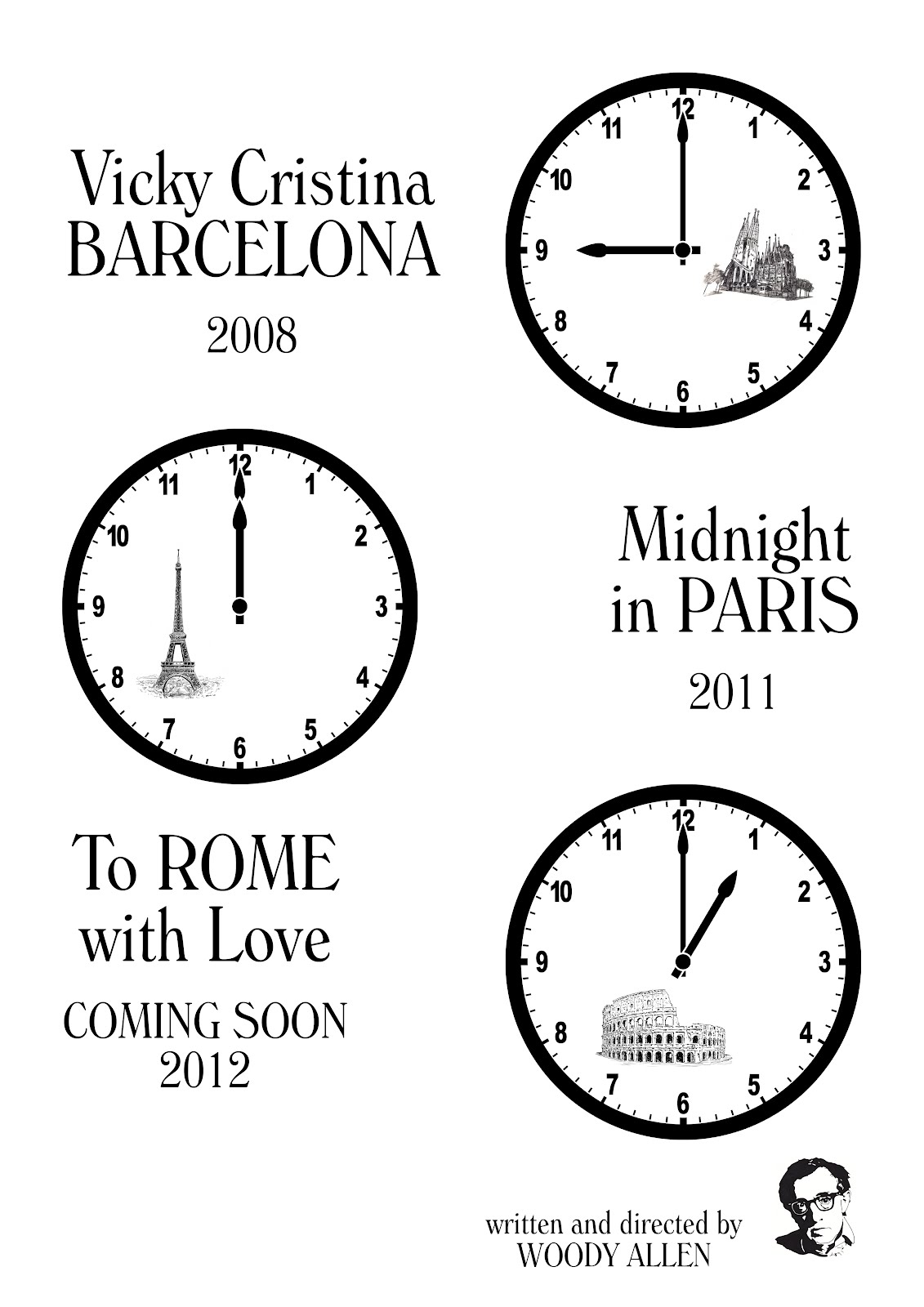
Windsor is just Woody Allen's type

In case you're wondering, we're talking typefaces here, and, specifically, the one Woody Allen has used in the titles of most of the films he has directed.

Windsor is a playful display face with heavy rounded serifs designed by Elisha Pechey in 1905 for the Sheffield type foundry Stephenson Blake. Times New Roman it ain't. It's the kind of typeface you might have expected to have seen in adverts pasted on to the sides of buildings in London or New York a century ago. Today it announces Woody Allen as surely as Johnston type does the London Underground.

The story goes that Allen was looking for a typeface for Love and Death (1975). At the time he ate breakfast in the same New Jersey diner as Ed Benguiat, the great American typographer (and jazz percussionist), who recommended Windsor. Allen liked it, and that was that. Windsor became a signature of his films, along with old jazz tunes, thick-framed specs, fast-paced dialogue and neurosis.

Well, not quite that. You may or may not be surprised to learn that there are websites that discuss Allen's choice of Windsor in the kind of detail that's as intense as his scripts. Did Sleeper beat Love and Death in the Windsor stakes? Which is it really – Elongated or Light Condensed? What's certain is that Allen has used Windsor in at least 36 of his 46 films. He clearly adores Windsor as much as he does New York.

Article source: The Guardian

Windsor typeface

Capitals M and W are widely splayed, P and R have very large upper bowls. The Lowercase a, h, m and n of the Windsor font have angled right hand stems, e has an angled cross-stroke. Besides the basic font it is also available in two other styles, Light and Roman. Various foundries introduced minor variations so that today there are versions by Linotype, Elsner+Flake, URW++, Mecanorma and Stephenson Blake.

Movie posters: Kairike (Photoshop, InDesign)

Monday, April 16, 2012

Push to add drama


To launch the high quality TV channel TNT in Belgium the company placed a big red push button on an average Flemish square of an average Flemish town. A sign with the text "Push to add drama" invited people to use the button. See what happened :)

TNT. We know drama.

Saturday, April 14, 2012

Google Doodle

Love the logo Google has today for Robert Doisneau's 100th birthday.


French photographer Doisneau is renowned for his 1950 image Le baiser de l'hôtel de ville (Kiss by the Hôtel de Ville), a photo of a couple kissing in the busy streets of Paris.


Photo: AllPosters.com

Wednesday, April 4, 2012

Graphic Design: Composition

HOMEWORK ON COMPOSITION:

1. Using your computer and only circles create two compositions:
  • "Traffic jam"
  • "Calm breeze"
2. Using your computer and circles as well as rectangles create two compositions:
  • "Landscape after the battle"
  • "The sky is falling"


Sunday, March 11, 2012

Monday, November 14, 2011

History and Visions: Lesson 1


Thursday, November 3, 2011

Productivity Future Vision (2011)

Watch how future technology will help people make better use of their time, focus their attention, and strengthen relationships while getting things done at work, home, and on the go.

Interactive art that you can make online


National Gallery of Art NGAkids Art Zone

NGAkids helps children develop interpretive and analytical skills through interactive discussions of paintings and sculpture in the National Gallery of Art, educational explorations, online interactive activities, and interactive art projects.

For example, SEA-SAWS where kids can select photographs of natural and man-made objects, then arrange the pieces to create a seascape or an abstract composition. The BUILD tool helps you construct animated characters and set them in motion.


To view the Art Zone interactives you need Adobe Shockwave Player. Adobe Flash is used for animations and slideshows. QuickTime is used for movies and VR.

Status conscious?


By Daryl Lang

Monday, October 31, 2011

The world is at seven billion. What's your number?

On October 31, 2011, the world population hit 7 billion.
Click on the photo to find out what's your number.


AFP/Getty Images/EMMANUEL DUNAND

IFI7101: Final Essay

What are new standards for writing narratives with new media?

New media – how we show what we know in the digital age.
Jason Ohler

Modern literacy has always meant being able to both read and write narrative in the media forms of the day, whatever they may be. Just being able to read is not sufficient. According to Jason Ohler, author of several publications on new media and digital storytelling, being able to read and write multiple forms of media and integrate them into a meaningful whole is the new hallmark of literacy.

Explaining narrative and new media

For a better understanding of writing narratives with new media, some explication on both concepts, „narrative“ and „new media“, is essential. A simplistic definition describes narrative as a story or account of events, experiences, or the like, whether true or fictitious; or a book, literary work, etc, containing such a story. Narrative can also be seen as the art, technique, or process of narrating. /8/ Marie-Laure Ryan (2004, p. 337) gives a more sophisticated definition characterizing a narrative text as „one that brings a world to the mind (setting) and populates it with intelligent agents (characters). These agents participate in actions and happenings (events, plot), which cause global changes in the narrative world. Narrative is thus a mental representation of causally connected states and events that captures a segment in the history of a world and of its members.“ In media terms, narrative is the coherence or organisation given to a series of facts. The human mind needs narrative to make sense of things – we connect events and make interpretations based on those connections. In everything we seek a beginning, a middle and an end. We understand and construct meaning using our experience of reality and of previous texts. /9/ Therefore, narratives play an essential role in our lives.

New media, the second fundamental concept, is a rather broad term that emerged in the later part of the 20th century to encompass the amalgamation of traditional media, such as film, images, music, spoken and written word, with the interactive power of computer and communications technology, computer-enabled consumer devices and most importantly the Internet. /10/ The initially expensive and difficult world of new media has quickly become so inexpensive and easy to use that anyone with an average computer and a small budget is able to actively create rather than just passively consume media. The rise of new media has increased communication between people all over the world and the Internet. It has allowed people to express themselves through blogs, websites, pictures, and other user-generated media. We live in the Digital Age. What does it mean? Quoting Ohler, on a technical level: we are bathed in bits; on an emotional, humanistic level: we are immersed in stories. In other words, the Digital Age has unleashed the Storytelling Age. /13/ We all get to tell our stories in our own way on the great stage of the Internet. This is our time; quite literally as Time Magazine named „us” as the person of the year on the cover of the December 25, 2006 issue. /17/

Do new media produce new narratives?

Knowing the definitions, we can go on to pose a question whether new (digital) media also produce new narratives. Ryan (2004, p. 337) starts Chapter 12 in her book Narratives across Media: the Languages of Storytelling with the following question: „Who should we follow: George Landow, who claims that hypertext will reconfigure the narrative experience by turning readers into coauthors; Janet Murray, who regards digital media as a new stage on which old narratives will be replayed in new dimensions (as the title of her book Hamlet on the Holodeck suggests); Espen Aarseth, who thinks that the future of cybertexts lies not in storytelling but in computer games; or Katherine Hayles, who equates digital meaning with complexity, fragmentation, fluidity, resistance to totalization, aporia, paradox, emergence, or self-organizing capabilities – features more likely to bring in a post-narrative, post-human literature than to transform the basic conditions of narrativity?“

When we think of traditional narratives, we usually rely on a sequence of events. Most old media objects such as print fiction, newspapers, television shows, and cinema, normally tell stories, which have a beginning and an end. But how is it with the sequence in new media? Lev Manovich (2001, p. 194-195) argues that „after the death of God (Nietzsche), the end of grand Narratives of Enlightenment (Lyotard), and the arrival of the Web (Tim Berners-Lee), the world appears to us as an endless and unstructured collection of images, text, and other data records.“ According to Manovich, the fundamental forms of new media are therefore the database and the algorithm, a sequence of simple operations a computer can execute to perform a given task. In computer function, the algorithm plays process „yang“ to the database’s content „yin“; they are both necessary to the working computer. Video games present an example of the use of algorithm in new media. In pursuing the goal associated with winning a game, the player usually follows a simple implied instruction set, an algorithm. The pursuit of this goal through the algorithmic set of instructions is what gives the player the experience of a narrative.

Jenny Vogel, an artist whose work explores the world as viewed through new media technology using web cameras, blogs and Google searches as source material, introduced her 2010 exhibition in New York, The Narrative Arc: Methods of Storytelling in Visual Art, saying that „narratives are based on a sequence of events, no matter how improbable, as long as it sets off an emotional tick, to which subsequent episode can provide an answering tock.“ /20/ According to Vogel, the moving image, the graphic novel, or digital art might be the most obvious media where both text and image collide, providing a bridge between the two disciplines. The two distinct examples of new media narratives, video games and visual art, indicate the existence of a variety of different ways in which a story can be unfolded in new media environments, yet they still rely on some form of sequence and relationship, connecting the „yin“ with its „yang“ or the „tick“ with its „tock“.

But let us come back to the more ubiquitous meaning of storytelling and narratives. In everyday situations, we usually do not think in terms of algorithms, and not all of us are gifted to convery images into meaningul stories, yet we all create narratives and we all leave an imprint. Storytelling has been with us for thousands of years, but during the age of new media it has taken on new expression and new meaning. It is with the variety of digital tools that ordinary people can finally tell their own real-life stories. Within half of a century, we have shifted from the consumption based storytelling culture (the traditional mass media) to a culture that listens and tells stories. According to Ohler, the lag time between new media evolving from read-only to write-possible is shrinking dramatically. He describes the current era as the beginning of Web 3.0 – an intelligent, semantic ecosystem that inevitably we will all „write“ by virtue of how we create content. It is a read-write web within everyone’s grasp and it promises to change anything we do that is web-based – in other words, absolutely everything. /11/

Today, with just a little training, the least technical among us can create a basic weblog in minutes. With a little experience, we can turn our blogs into media-rich information sources thanks to YouTube, SlideShare and other services that make it easy for the non-technicians to produce their own media. The new media diaries substitute the traditional paper diaries. Books still exsist, but they are often read on digital devices such as Kindle or most recently the iPad, which means they must also be produced for these new formats. A recently posted YouTube video, A Magazine Is An iPad That Does Not Work, shows how magazines are now useless and impossible to understand, for digital natives. It shows real life clip of a 1-year old, growing among touch screens and print. And how the latter becomes irrelevant. /19/ Writing letters in ink can no longer compete with e-mails. School work is not scribbled in sketchbooks, instead it is posted on blogs. Essays are no longer plain text, instead students are encouraged to create digital stories integrating multiple forms of media. The idea of merging traditional storytelling with today’s digital tools is spreading worldwide and across different fields, most commonly in education.


What are new standards for writing narratives with new media?

Ryan (2004, p. 338) singles out five properties of digital media as the most fundamental that affect narrativity: reactive and interactive nature, multiple sensory and semiotic channels (multimedia capabilities), networking capabilities, volatile signs, and modularity.

These properties are used to create new media narratives, such as distributed narratives, spread across time, space and the network; sequential fragmented narratives, segmented and ordered into small chapters or tweets and made available to a broad audience; aggregated narratives, which use algorithm or search to draw the narrative together; spatial narratives, embedded into real geographical locations with itineraries for exploring the novels parallel in real and virtual world. New media offer a wide range of new ways to present stories as well as new modes of user involvement: exchanging stories in real time, impersonating a character, and participating in the collective creation of a story. Narrating in new media environments is liberating and demanding at the same time. „We increasingly have affordable and ubiquitous tools to help us communicate and enrich engaging narratives. We now need a new generation of leaders to put these tools to good use,” says John Hagel, co-chairman at Center for the Edge. /4/

A lot of discussion on new media narratives has been around its non-linearity. Various authors have questioned whether some of the new media narratives can be called narratives at all. I had a great chance to listen to Pedro Monteiro, a Portuguese graphic designer, on the INMA European Conference 2011 in Lisbon. Discussing narratives for digital distribution, he confronts these critics by bringing examples of traditional (print) narratives that are non-linear, because of physical space constraints that pages impose and the way graphic design copes with it. Pictures, text, captions, etc, all relate to the story being told, but the way the bits of the story are laid out reinforces its non-linearity. Monteiro does not focus on the timeline, but on interruptions of the narrative itself. He explains how we can prevent it on digital publishing. In a good storytelling experience, a linear one, each item that exists to aid the main story is placed in an exact location. In a digital narrative, storytellers are not obligated to choose text over audio, or pictures over video. They must choose the best way to communicate each bit, each episode. The choice should flow from the content itself. Added material for a story must be presented in a way that can either be fully explored by a reader, or moved forward, without loss for the narrative experience. The final linear narrative will be a flow of content, presented using every digital tool available. Monteiro believes that with the advent of digital devices and rich new ways of shaping content, it is time to rethink how we produce and present our stories. /7/

An interesting form of new media storytelling is transmedia storytelling, also known as multiplatform storytelling. It is the technique of telling stories across multiple platforms and formats using current digital technologies. From a production standpoint, it involves creating content that engages an audience using various techniques to permeate their daily lives. In order to achieve this engagement, a transmedia production will develop stories across multiple forms of media in order to deliver unique pieces of content over multiple channels. Importantly, these pieces of content are not only linked together, but are in narrative sync with each other. /18/ As of 2011, both traditional and dedicated transmedia entertainment studios are beginning to embrace transmedia storytelling techniques in search of a new storytelling form. Developing technologies have enabled projects to now begin to include single-player experiences in addition to real-time multiplayer experiences such as alternate reality games.

Some notable examples of transmedia storytelling include: Cathy's Book, a transmedia novel by Sean Stewart; Slide, a native transmedia experience for Fox8 TV in Australia; ReGenesis, a Canadian television series with a real-time transmedia (alternate reality game) extension that took place in sync with the episodes as they aired. To further explain this, let us take Slide. The Australian teen drama series follows the lives and exploits of five teenagers making their way into adulthood in the city of Brisbane, Queensland. The series is multi-platform and encourages the viewer to view extra content online via apps and social networking such as Facebook and Twitter. Webisodes of events that take place before and after episodes are also available on YouTube. /16/

Another form of writing narratives with new media is microblogging. I consider it quite an opposite practice. While transmedia storytelling uses multiple forms and platforms to permeate our daily lives, microblogs consist of small elements of content such as short sentences, individual images, or video links. /6/ For example, the 140 Novel, a Twitter-based novel by three people writing a single sentence each time in a single account. That is where the name 140 comes from, the character limit on Twitter. /1/ Similarly, Facebook Timeline will soon offer the social network users to tell their life story in a short but telling way, with a new kind of profile composed of the most memorable posts, images, and a new class of social apps that let the users express who they are through the things they do. /3/


These are only a few possibilities offered by new media to produce creative alternatives to a narrative experience. And it remains the storyteller’s choice to decide on the best technique to communicate the story.

Why do we need narratives so bad?

Hagel discusses narratives and their place in this post-modern era. According to Hagel, narratives provide stability and continuity in our lives. When confronted with a growing barrage of demands on our attention, they help us to filter, select and prioritize what should receive our attention. By inviting people to take initiative, narratives encourage people to lead. They also help participants construct meaning, purpose and identity for themselves, to situate participants in a broader context and to build relationships across participants. At their most profound level, narratives help to ignite and nurture passion within us. /4/

Ohler adds from the educational perspective, that being able to actively create rather than just passively consume new media is important for the obvious reason that it teaches literacy and job skills that are highly valued in a digital society. Hands-on media creation plays an important role in the development of media literacy – the ability to recognize, evaluate, and apply the techniques of media persuasion. Writing media compels reflection about reading media, which is crucial in an era in which professional media makers view young people largely in terms of market share. Thus, a new dimension of literacy is now in play – namely, the ability to adapt to new media forms and fit them into the overall media collage quickly and effectively. „Committing a bad story to digital media is like giving a bad guitar player a bigger amplifier,“ he says. /12/

Center for Digital Storytelling, an international nonprofit training, project development, and research organization, assists youth and adults around the world in using digital media tools to craft and record meaningful stories from their lives and share these stories in ways that enable learning, build community, and inspire justice. /2/ At the core of their work is a commitment to narrative, an enduring respect for the power of individual voices and a deep set of values and principles that recognize how sharing and bearing witness to stories can lead to learning, action, and positive change. Storytelling has a history rich in timeless skills, perspective and sense of audience. Good teaching is often a matter of good storytelling.

In conlusion

To conclude, I would say that new media do produce new narratives. To me the biggest and perhaps the most important difference that comes with this change is that now everyone is able to tell stories, rather than only read or listen. This fact by itself creates a variety of different narrative forms.

What does not change is the reason why we produce narratives. That is to make sense of things around us, to understand and construct meaning. Therefore, I also agree with Ryan (2004, p. 354) when she says that „digital media have no more impact on the cognitive model through which we filter texts and make sense of human action than the experiments of postmodern fiction. The texts supported by digital media may satisfy to various degrees the universal cognitive model, or they may produce creative alternatives to a narrative experience, but they do not and cannot change the basic conditions of narrativity.” No matter how high tech we become, telling stories to each other orally will endure as one of our primary and most powerful forms of communication. It will always be an important skill to have in the workplace, in our communities and in our schools. „Bottom line: No matter how sophisticated our technology becomes, the future of digital storytelling will involve writing and conventional forms of literacy,“ says Ohler. /12/ A short YouTube video, Change Your Words, Change Your World, beautifully empasizes this powerful role of words. /15/


However, digital media affect narratives. They offer new modes of user involvement and new things to do with narrative: exchange stories in real time, impersonate a character, and participate in the collective creation of a story. They also produce new ways to present stories, which necessitate new interpretive strategies on the part of users. However, the impact of digitality on narrative is not a matter of developing a new logic but, rather, a matter of finding the right fit between the medium and the form and substance of the narrative content. Technological innovations liberate new narrative energies and exploit new possibilities, but „the survival of narrative does not depend on its ability to adapt itself to new media. Rather, it is the future of new media as a form of entertainment that depends on their ability to develop their new forms of narrativity,” concludes Ryan (2004, p. 356).

References

  1. 140 Novel. twitter.com/140novel. Retrieved October 20, 2011.
  2. Center for Digital Storytelling. www.storycenter.org. Retrieved October 20, 2011.
  3. Facebook Timeline. www.facebook.com/about/timeline. Retrieved October 20, 2011.
  4. Hagel, John. The Pull of Narrative – In Search of Persistent Context edgeperspectives.typepad.com/edge_perspectives/2011/05/the-pull-of-narrative-in-search-of-persistent-context.html. Retrieved October 20, 2011.
  5. Manovich, Lev. The Language of New Media. The MIT Press, 2001. 354 pages.
  6. Microblogging. Wikipedia.org. en.wikipedia.org/wiki/Microblogging. Retrieved October 20, 2011.
  7. Monteiro, Pedro. Narratives for Digital Distribution. digital-distribution.org/2011/07/03/narratives-for-digital-distribution. Retrieved October 21, 2011.
  8. Narrative. Dictionary.com. dictionary.reference.com/browse/narrative. Retrieved September 30, 2011.
  9. Narrative. Mediaknowall.com. www.mediaknowall.com/as_alevel/alevkeyconcepts/alevelkeycon.php?pageID=narrative. Retrieved September 30, 2011.
  10. New media. Wikipedia.org. en.wikipedia.org/wiki/New_media. Retrieved September 30, 2011.
  11. Ohler, Jason. Beyond Words: New Media Literacy, Fluency and Assessment in Education. www.jasonohler.com/storytelling/beyondwords.cfm. Retrieved October 20, 2011.
  12. Ohler, Jason. Digital Storytelling in the Classroom: New Media Pathways to Literacy, Learning and Creativity. Part I – Storytelling, Literacy and Learning. www.jasonohler.com/storytelling/storyeducation.cfm. Retrieved October 20, 2011.
  13. Ohler, Jason. Digital Storytelling in the Classroom: New Media Pathways to Literacy, Learning and Creativity. Part II – The Art of Storytelling. www.jasonohler.com/storytelling/storymaking.cfm. Retrieved October 20, 2011.
  14. Ryan, Marie-Laure. Narrative across Media: The Languages of Storytelling. University of Nebraska Press, 2004. 422 pages.
  15. Sethagardner. The Power of Words. YouTube. youtu.be/Wgi0t2ap-us. Retrieved October 20, 2011.
  16. Slide. www.fox8.tv/shows/slide. Retrieved October 20, 2011.
  17. Time Magazine. Cover of the December 25, 2006 issue.
  18. Transmedia storytelling. Wikipedia.org. en.wikipedia.org/wiki/Transmedia_storytelling. Retrieved October 20, 2011.
  19. UserExperiencesWorks. A Magazine Is An iPad That Does Not Work. YouTube. youtu.be/aXV-yaFmQNk. Retrieved October 20, 2011.
  20. Vogel, Jenny. The Narrative Arc: Methods of Storytelling in Visual Art. untonthesquare.unt.edu/narrative-arc-methods-storytelling-visual-art. Retrieved October 1, 2011.