Showing posts with label IFI7144. Show all posts

Thursday, December 16, 2010

Task 14: Final reflections

The course of New Interactive Environments (NIE) is coming to an end and here are my reflections on the last couple of months.

Before I go on with my personal experience, observations and suggestions, I'd like to say that it actually depends very much on whether the course was supposed to be rather theoretical or more practical. Without a doubt, Terje and Sebastian provided us with adequate reading materials and useful theories. If the meaning of the term 'interactivity' was somewhat blurred to some us before, then it should be quite clear now. I enjoyed searching for my own understanding of interactivity, one of the "apply theory in practice" kind of tasks.

So, half of the purpose of the course was well achieved. Before analyzing or using any interactive environments, it is necessary to understand what interactivity is, how it can be measured and what difference it makes to us in the world of digitally mediated interaction. However, I feel we didn't take full advantage of the possibilities to make the course itself interactive, and this is not brickbat on the facilitators' address only. I remember Terje and Sebastian tried to squeeze out some activity from us, participants, during the first and the second Flashmeeting session, but what do you do with these reserved and buttoned-up Estonians, right?

Anyway, although there seemed to be a certain reason why the organization of the course remained rather secretive, I personally would have preferred to know the topics we were going to learn in advance, in a well set out course layout. I believe this would have made the learning process more effective. Referring to the same Flashmeeting session where we tried to simultaneously write things down in Piratepad, it would have worked out better if we had been given a more concrete task, or would have known the destination we were moving to. Only later (with Task 11) it probably made more sense what we were doing back then. Talking about the communication tools, I found Skype very practical in another course where we had a weekly Wednesday night group chat. It's better to follow, the chat history is saved and can be read afterwards even if you can't be present during the chat but are in the group. Flashmeeting kept logging me off, especially when we used Piratepad at the same time.

I'd like to suggest combining different forms of course participation (blog posts, forum, group chat, wiki). In NIE, all the tasks followed the same structure: read an article, explore the theory and put out a post on your Weblog. This generated reviews and summaries on the same articles in 10 different rewordings (formulations) but at the same time limited the outcome to a very few examples. To be able to analyze my experiences with NIE, I have to compare it with the other online courses I took this semester. In one of them, where we knew the topics for each of the 14 weeks, all of us were given the same weekly task but the task usually had different outcomes, because we were mostly asked to find an example to represent the topic of the week. This made reading other students' blog posts more interesting as all of them taught something new. A good way to follow these posts could be social bookmarking as done, for example, in the PLENK2010 course. Many social bookmarking services provide web feeds which allows subscribers to become aware of new bookmarks as they are saved, shared, and tagged by other users.

The other night we had our small pre Christmas dinner with some IMKE students and we discussed a little bit about the courses of this semester. Most of us agreed that online courses, although they are supposed to enable independent learning, should still include some more teaching. It's easy to get lost from the right path when you are trying to make sense of the material alone. Most of the times students are given the option to ask when they have a question (by e-mail or other form), but they often don't bother. Yet these questions, hesitations and mistakes can be noticed by the facilitators when they read through the blog posts. I would personally appreciate it a lot if the facilitators brought them up in the following group chat and explained both where we nailed it and where we missed the guess. I would also appreciate it if there were some explanations and thoughts written about specific topics also by the facilitators before students are asked to carry out a task on it, as in a traditional class where lecturer first explains something, shares the knowledge, and then comes the homework.

These are my feelings about the first semester. I took three online courses. And it took me some time to get used to it as during my Bachelor, which I finished 4 years ago, I probably only had a few of them altogether. I sometimes struggled to find motivation to go through the material by myself, other times I missed listening rather than reading, but I'm glad I'm learning so much new and absolutely intriguing things that IMKE has got to offer. And I'd like to thank Terje (and Sebastian) for being part of it and for putting their effort into it.

Thursday, December 9, 2010

Task 12: Tool or medium?

There has been a tremendous change in the way people live, work and play over the past couple of decades, since the Internet reached a critical mass in the early 1990s and the adoption of personal computer by the public allowed rapid global communications and networking to shape modern society. The past ten years or so have seen changes at a much faster pace. Modern digital technology in its various forms (PCs, notebooks, netbooks, tablets, pocket-sized devices, and the web applications or Web 2.0 phenomenon) has been the key player in promoting these changes.

"Technology runs in the veins of society. It is the fuel that drives our lives. It is an integral part of daily life. It has definitely benefited society. It has brought luxury in the life of the common man," writes Manali Oak on Buzzle.com. While this is true that the automation brought about by technology (for example the electronic gadgets that have entered the homes of the common man) has saved human effort and time to a large extent, we could hardly find a more general term to decribe computers and their importance in the societal activity than to define them as mere tools or just instruments.

According to Rückriem, "Computer technology, taken as a tool, is just a new technology like many others, say e.g. motorcars or airplanes." Cars and planes change our activity when we make use of them, but they change it not, if we don't. They make a difference in societal practice, but we can always find alternatives to using them. At the same time, it is becoming more and more obvious that computer technology is in fact without any alternative, unavoidable, irreversible, general and even universal. It changes not only one specific concrete activity but revolutionizes the societal activity structure as a whole. "There is no revolution with broader or more fundamental consequences than the invention of book printing or computer technology. There is no medium with a broader range of impact. In our days it touches even the last tribe in the Brasilian jungle," finds Rückriem. Therefore, as Rückriem suggests, if we insist on characterizing computer technology as a "tool", we must be aware that it is a tool of its own with quite a different quality, or better yet, we need a qualitatively different and unmistakable concept. That means the concept of "medium", where media are both: material substratum and meaning, actuality and potentiality at the same time, storing not only specific technologies but the specific form of societal activity.

The computer technology, needless to say, has changed the face of the world. There is no doubt the uses of technology and society interact strongly. Computers can store, organize and manage huge amounts of data and process large amounts of information. Internet that seeded from the computer networking concepts is the most effective communication platform and the largest information base existing today. Web 2.0 sites and applications give users the no choice but to interact or collaborate with each other in a social media dialogue as both producers and consumers of user-generated content in a virtual community. The Web is therefore "a collaborative medium", a place where we can all meet to read and write. The expansion of media production through new technologies that are accessible and affordable to the general public (including all digital media technologies, such as question-answer databases, digital video, blogging, podcasting, forums, social networking, mobile phone photography and wikis) has probably made the interaction of technology and society the one thing more than any other that gives society a meaning and defines us as human beings.

However, in recent years it has become popular to point fingers of accusation at technology as if it were "autonomous" and driving us all to perdition. But isn't it rather naive to think of aggressive technology affecting a passive society? Admittedly, there is always the potential for abuse or misuse of a technology, but technology is not inherently destructive. Or as Feenberg says, "Guns don't kill people, people kill people". In the same way, it is upto us how constructive or destructive use we make of the tools and media provided to us by the current Digital Age. It is also true that information and communication technology has involved us in technology so intimately that our activities have begun to shape its development. We are working towards even better technical solutions and quite obviously an even more integrated relationship between technology and society, but we do it because it brings along some explicit and evidential advantages for important institutions, such as schools, social work services, public health system, and sciences, to name a few. These advantages are able to outweigh the disadvantages as long as we are able to keep things under control. (If we can, is another question.)

To conclude, I think it is unquestionable that digital computer technology represents a fundamentally outstanding technical revolution which changes our living and working completely, and revolutionizes our societal practice as a whole. It is a combination of a "tool" that has proved helpful for both the critical processes in the industry as well the household and a "medium" that gives contemporary society a meaning. There is no question whether we should or could or shall ignore it. We cannot resist or struggle against technological innovation, at least not when we keep finding it so attractive and utterly useful. As Rückriem says, "It [computer technology] seems to mark an already ongoing process of new drafts of our societal existence as a whole emerging. Its revolutionary importance is therefore not comparable to any other existing technology. No political revolution is comparable with computer based globalization. This urges us to reflect on digital information and telecommunication technologies as catalysts of a new social system emerging."

Sunday, December 5, 2010

Task 11: Our components versus components of activity theory

New Interactive Environments

To keep it simple, I agree with Terje's interpretation of the activity theory and its usefulness in practice: "I think the power of the activity theory actually lies in its flexibility and freedom to interpret it according to one's needs. It provides vocabulary for talking about human activity systems, it provides components of the activity to focus on and determines connections between them. It provides one of the ways to look at what humans do and how."

Trying to describe interactive environment as a human activity system, what could be the components and the relationships between them? While searching for my own understanding of interactivity, I saw it as a measure of a media's potential ability to help the user connect, interplay, socialize, retrieve, personalize and exchange information, give feedback, form and participate in communities, or in other words, a means that helps to keep the interpersonal communication alive at any time, anywhere, with anyone we choose to. Therefore, one way to look at the system is to describe user as the subject of the interactive environment, while the object is the array of opportunities to build the environment, and the outcome that user strives for is the human to human interaction (communication, collaboration). Taking a personal perspective, tools are the personal media we use to communicate (from pen and paper back in the old days to emails, (Internet) phone and video calls, instant messengers, SMS and so on in the current age). Community can be a small group of the closest friends to a global network of people with the same interests. Rules exist in the form of etiquette or netiquette (network etiquette), and division of labour can be seen as the different roles users take in the community.

When we tried to describe activity system at the beginning of the course, we thought of it more like a project rather than an interactive system. We were able to instantly name and define components such as start, end, timeframe, time management, plan, schedule, resources, restrictions, etc. An activity system is a logical collection of activities designed to fulfill some purpose, which means that often times it has a certain timeframe, plan and resources, but sometimes these components are irrelevant. One example of interactive environment is our course NIE. It started in October and ends in December, and whatever the subject and the object are (depending on the perspective, students versus facilitators), it has a timeframe. We can also think of interactive environment applying the activity theory in our personal life where interactions are not always planned and some components become irrelevant. However, without a clear perspective, in terms of the activity system we were supposed to describe, I think we listed most of the necessary components, including mediators (tools, rules), but we didn't define relation(ship)s between the components. Although we didn't specify the subject and the object (which would have helped us to shorten the list), we covered the basic structure of an activity system. We also listed the components (such as process, task, options, sequence) necessary to decompose activity into actions and operations in order to analyse the activity structure. There were some components that the basic framework of the activity theory does not clearly mention but which are closely tied to the outcome, such as feedback and evaluation (of quality, workmanship).

Trying to compare our components with the components of activity theory

Monday, November 15, 2010

Task 9: Exploring activity theory as a framework for describing activity systems

New Interactive Enviroments
An activity is the minimal meaningful context to understand individual actions.

An activity system is a logical collection of activities designed to fulfill some purpose.
Basic structure of an activity

As explicated by Kuutti (1995), this systemic model, based on the conceptualization by Engeström (1987), contains three mutual relationships between subject, object and community. The relationship between subject and object is mediated by "tools", the relationship between subject and community is mediated by "rules" and the relationship between object and community is mediated by the "division of labour". A "tool" can be anything which is used in the transformation process, including both material tools and tools for thinking; "rules" cover both explicit and implicit norms, conventions and social relations within a community; "division of labour" refers to the explicit and implicit organization of a community as related to the transformation process of the object into the outcome.

Summarising activity theory and its potential for describing activity systems

Activity theory as a psychological meta-theory, paradigm, or framework is dynamic. It can be used by a variety of disciplines to understand the way people act. Founded by Leont'ev and Rubinshtein in the former USSR, activity theory became widely used in both theoretical and applied psychology, in areas such as education, training, ergonomics, and work psychology.

In the study of human-computer interaction and cognitive science, activity theory can be used to provide a framework for informing and evaluating design. In a framework derived from activity theory, any task, or activity, can be broken down into actions, which are further subdivided into operations. In a design context, using these categories can provide the designer with an understanding of the steps necessary for a user to carry out a task. One of the most frequently quoted books on the application of activity theory in human-computer interaction is written by Bonnie N. Nardi (1996).

Examples from computer and information studies are ample. A re-examination of information seeking behaviour in the context of activity theory, applies the key elements of activity theory to the conduct of information behaviour research, where the activity-theoretical approach provides a sound basis for the elaboration of contextual issues, for the discovering of organizational and other contradictions that affect information behaviour. Everyday inclusive Web design: an activity perspective, uses a method where the design activities of end-users and system designers are modeled using activity theory. Activity models and scenarios are used to describe and analyze design activity. From activity to learning: using cultural-historical activity theory to model school library programmes and practices, where activity theory, as a model that takes a developmental view of minds in context, is particularly well suited. The paper focuses on the activity theoretic concepts of contradictions and expansive learning as they relate to the development of best practices. Library activity is illustrated from multiple perspectives using a triangulated, qualitative approach.

Even though it might seem like another figure explaining a theoretical approach, it becomes more practical when actually applied. Real life situations always involve an intertwined and connected web of activities which can be distinguished according to their objects. Participation in connected activities having very different objects can cause tensions and distortions. The whole picture starts to make sense when filled with relevant details, such as the right subject, object and community with the mediating tools, rules and division of labour. However, Kuutti suggests that the model should be understood rather broadly. Each of the mediating terms is historically formed and open to further development. Let us take a closer look at one of the researches mentioned above.

A sample case: everyday inclusive Web design

Everyday inclusive Web design is a design perspective that promotes the creation of accessible content by everyday end-users, as website accessibility (especially with more and more content being created by non-professionals) is a problem that affects millions of people with disabilities.

As we know from our personal experience of being surrounded by an ever growing number of social applications (such as YouTube, Flickr) and networks (for example MySpace, Facebook), recent developments in Web technology have provided new opportunities for end-users to participate as designers. The study looks how professional system designers and end-users each engage in design activities within social software systems. As these activities are not independent, but rather interact with one another to produce the final site content, activity models and scenarios are used to describe and analyze the process and its possible contradictions.

I quite enjoyed how Kuutti points out that in activity theory contradictions are seen as sources of development; real activities are practically always in the process of working through some of such contradictions. It is through these contradictions (problems, ruptures, breakdowns, clashes, etc) that we improve ourselves or the systems and technologies we work with. In the case of everyday inclusive Web design, contradictions found between personal expression and publishing objectives in end-user design activity, as well as contradictions between perceived and actual number of system users with disabilities lead to inaccessible design. With the help of the activity model, these issues were clearly visualized in order to provide suggestions and solutions for improvement.

In short, the study was able conclude that accessibility of social software systems depends on the cooperative work of system designers and end-users. The underlying structure of social software systems may be altered to increase users' awareness of accessibility issues and to encourage accessible design practices. Both system designers and end-users must act with accessibility in mind in order for the end result to be accessible. End-users require access to design tools that support accessible design practices, while system designers must instruct end-users about available accessibility features.

Saturday, November 13, 2010

Task 8: From mass media to personal media

New Interactive Environments

Lüders, M. (2008). Conceptualizing personal media.
We have learnt that new media communication technologies enable and facilitate user-to-user interactivity and interactivity between user and information. Internet, the network of networks that consists of millions of private, public, academic, business, and government networks, of local to global scope, connects billions of users worldwide and replaces the "one-to-many" model of traditional mass communication with the possibility of a "many-to-many" web of communication, where any individual with the appropriate technology can produce his or her online media.

The new media with technology convergence shifts the model of mass communication, and radically shapes the ways we interact and communicate with one another. The article by Marika Lüders describes how the digitalization and personal use of media technologies have destabilized the traditional dichotomization between mass communication and interpersonal communication, and therefore between mass media and personal media (e.g. mobile phones, email, instant messenger, blogs and photo-sharing services). It also aims to point out some social implications of the recent and ongoing development of digital personal media.

The rise of new media has increased communication between people all over the world and the Internet. With the development and appropriation of digital personal media, mediated social interaction has the potential to be near all-pervasive in our everyday life. It has allowed people to express themselves through blogs, websites, pictures, and other user-generated media. Lüders writes: "The combination of the Internet, PC and evolvement of less expensive and more manageable media production tools give leeway for the amateur media producer. Anyone becomes qualified to be a media producer and is likely to have an audience to their productions. Examples are ample. The successes of photo-sharing services such as Flickr  and Deviantart are only two cases that consolidate the thesis of the amateur media producer." This means that individuals now have a means to exposure that is comparable in scale to that previously restricted to a select group of mass media producers. Individual users increasingly construct media messages, social discourses multiply and mass media institutions no longer reign as exclusive storytellers with audiences beyond immediate social and geographical borders.

At the same time, the importance of active and creative amateur users is stressed among key actors within the mass media industry, further complicating the distinction between personal media and mass media. In August 2006, CNN launched CNN Exchange (now CNN iReport), a service referred to as YouTube for news – you can submit your own newsworthy videos, audio clips and articles and perhaps see them on the site and TV. The problem, of course, is that CNN controls the whole experience. On the other hand, there are weblogs that, in recent years, have gained increasing notice and coverage for their role in breaking, shaping, and spinning news stories. Blogs often become more than a way to just communicate; they become a way to reflect on life, or works of art. Blogs have become the primary Internet medium for individual professional and non-professional self-expression. Few personal blogs rise to fame and the mainstream, but some personal blogs quickly garner an extensive following. Many bloggers, particularly those engaged in participatory journalism, differentiate themselves from the mainstream media, while others are members of that media working through a different channel. Some institutions see blogging as a means of "getting around the filter" and pushing messages directly to the public.

Therefore, as explained by Lüders, with the digitalization of media, in certain cases the same media technologies are used for both mass media and private individual purposes. For example, the Internet is the technological foundation of both commercial online magazines and personal homepages. Sharing the technologies, however, does not mean that distinctions between mass media and personal media are no longer pertinent. Personal media are distinguishable from mass media, if not always technically, then at least socially. Technologies in practice take on different meanings in different contexts. Technologies are more than their technical elements and media forms are more than their technology. Media forms are the result of the interrelations between media technologies and their function within our everyday lives. The Internet as technology constitutes various media forms, which then are characterized further by different genres. Blogs clearly fall into various genres: personal diaries, academic, research, travel, campaigning or food, among many others.

All this makes personally-mediated messages and user-generated content rather chaotic, compared to traditional mass media, and requires people to be multimodal-literate: handling a complex mix of audiovisual-textual media technologies, producing and deciphering meanings. Yet the advantages that the new kind of media has enabled for us as media producers and consumers are preponderate. Vin Crosbie, media industry consultant and professor of New Media at Syracuse University, describes in "What is New Media?" the new media as individuation media that has the advantages of both the interpersonal and the mass media, but without their complementary disadvantages.

No longer must anyone who wants to individually communicate a unique message to each recipient have to be restricted to communicating with only one person at a time. No longer must anyone who wants at once to communicate message to a mass of people be unable to individualize totally the content of that message for each recipient.
As for the Lüders' article, the conclusion remained unclear to me. Does she consider the blurring borders between mass communication and interpersonal communication a problem or does she simply acknowledge the fact that it is happening – or has already happened? In one way or another, I tend to think that the mix is a benefit to both sides and both the interpersonal and the mass media can complement one another as seen in the arising new media.

Sunday, November 7, 2010

Task 7: In search for my own understanding of interactivity

The two articles on interactivity previously studied, „Interactivity: Tracking a New Concept in Media and Communication Studies“ by J. F. Jensen and „Interactivity: A Concept Explication“ by S. K. Kiousis, both confirmed that the concept of interactivity is certainly multi-discursive and thus depends to a very large extent on the context in which it is used for the meaning to be clear. This makes the search for our own understanding of interactivity a great quest to take on where no interpretation can be wrong.

According to J. D. Peters, author of the prophetic book called “Speaking into the Air: A History of the Idea of Communication”, the ideal of interactivity, the search for instantaneous contact with others, has a long and fraught history in western culture. He traced it back to St Augustine, for whom the epitome of perfect communication was the angel, a word derived from the Greek for “messenger”. Coming back to the 21st century, Jensen writes, “The culture has lived out what we might call an interactive turn“. Because interactivity as we know it today is so closely tied to technology, many of the explications – including the one elaborated by Kiousis – make mediated communication via technology a central attribute defining interactivity and exclude pure interpersonal communication.
Or as Peters argues, the aim of modern media has been to “mimic the angels by mechanical or electronic means”.

To illustrate the situation, I would like to share a video recently reviewed by one of my fellow students on his blog. The video that brought goosebumps to me, reminds us that interpersonal communication, even though often substituted – or, as it would be more correct to say, mediated – by the various means of interactive computer technology, continues to play an important role in our life.

From the academic perspective, we may analyze the term interactivity referring, first and foremost, to the fields of sociology, communication studies and informatics (including information and computer science), but when we think of interactivity, in search for our own understanding of one of the media community’s most used buzzwords, we often perceive it best in the context of personal experience. As the second half of the definiton by Kiousis explicates, „With regard to human users, it [interactivity] additionally refers to their ability to perceive the experience as a simulation of interpersonal communication and increase their awareness of telepresence.“ Moreover, most interactive computing systems are for some human purpose and interact with humans in human contexts.

Interactivity is a central concept in new media. In simple words, interactive new media holds out a possibility of on-demand access to content any time, anywhere, on any digital device, as well as interactive user feedback, creative participation and community formation around the media content. It also breaks the connection between physical place and social place, making physical location much less significant for our social relationships, and has the ability to connect like-minded others worldwide. Social interaction, using web-based technologies to turn communication into interactive dialogues, has become part of our personal and professional life. Popular networking sites such as Facebook and Twitter as well as personal weblogs are commonly used for socialization and connecting with friends, relatives, and employees, wherever in the world they may currently be.

Interactivity, the way I feel and perceive it, even though closely tied to technology, is a measure of a media’s potential ability to help the user connect, interplay, socialize, retrieve, personalize and exchange information, give feedback, form and participate in communities, or in other words, a means that helps to keep the interpersonal communication alive at any time, anywhere, with anyone we choose to. This communication is hoped to be a mutual (reciprocal) lively action, just like the words ’inter’ and ’activity’ presume and just like we expect communication to always be. True, we can also communicate and interact with a computer software, Internet website, or whatever other artifact, but I find the social connotations more cherished.

To answer the question whether interactivity as a concept has changed in the past 10, 100 or 1000 years, I believe the heart of it has remained the same. What changes constantly is the technology we employ to interact and the degree to which this technology makes the interaction possible. Patently, the level of interactivity varies within different media and is ever higher as more advanced technologies are introduced. Theoretical and operational definitons are useful to understand the background behind the concept, however, interactivity must be "touched and felt" (perceived) as part of our life to mean more than a concept explication to us.

Sunday, October 31, 2010

Task 6: Operationalising interactivity (article 2)

New Interactive Environments

Article summary

Kiousis, S. (2002). Interactivity: A Concept Explication.

As we read from the previous article by Jens F. Jensen, the meaning of interactivity has been relatively unclear ever since the word appeared in daily use with the rise of new media and communication technologies. The purpose of the project carried out by Spiro K. Kiousis, a professor at the University of Florida, is to engender a detailed explication of interactivity that could bring some consensus to how the concept should be theoretically and operationally defined.

Following Chaffee's framework for concept explication, the following steps were executed to complete the project: (1) provide a general background of interactivity; (2) survey relevant literature on the concept; (3) identify the concept's central operational properties; (4) locate present definitions of the concept; (5) evaluate and modify those definitions; (6) propose a conceptual definition; (7) propose an operational definition; and (8) discuss the implications on future research of the arrived-at definition.

Kiousis uses two dimensions to arrange the various conceptual definitions and cogent aspects of interactivity discussions from the fields of communication, sociology, psychology, and computer/science design: the object emphasized by scholars (technology, communication setting, perceiver), and the intellectual perspective from which the definition originates (comminication and non-communication). He organizes the different authors visually in a table and uses it as a reference for the remainder of his project.

According to Kiousis' modified definition, interactivity can be defined as the degree to which a communication technology can create a mediated environment in which participants can communicate (one-to-one, one-to-many, and many-to-many), both synchronously and asynchronously, and participate in reciprocal message exchanges (third-order dependency). With regard to human users, it additionally refers to their ability to perceive the experience as a simulation of interpersonal communication and increase their awareness of telepresence.

Operationally, interactivity is established by three factors: technological structure of the media used (e.g. speed, range, timing flexibility, and sensory complexity), characteristics of communication settings (e.g. third-order dependency and social presence), and individuals' perceptions (e.g. proximity, perceived speed, sensory activation, and telepresence). Operational measures are needed to examine each of these factors. Once the data is collected, it is transformed, producing technological, communication context, and perceived interactivity scores. Subsequently, an overall interactivity score can be manufactured.

On the whole, the operational definition offered not only describes the essence of the theoretical definition of interactivity, but may also help broaden the concept's boundaries. In comparison to previous versions, the interactivity definition provided by Kiousis is expansive, permitting analyses across media and individuals. Interactivity is understood as both a media and psychological factor that varies across communication technologies, communication contexts, and people's perceptions.

Inevitably, interactivity still remains a controversial concept.

Monday, October 25, 2010

Task 5: From interaction to interactivity, from sociology to informatics (article 1)

New Interactive Environments

What is interactivity?

In computer science, interactive refers to software which accepts and responds to input from humans; for example, data or commands. By comparison, noninteractive programs operate without human contact; examples of these include compilers and batch processing applications.

Interactivity is seen as a key association with new media as it basically sets apart the 'old' and new medias. Old media could only offer a sit-back type interaction, whereas new media is much more engaging to their audiences. Technologies such as DVDs and digital TV are classic examples of interactive media devices, where a user can control what they watch and when. However, the Internet has become the prime model of an interactive system. Users can become fully immersed in their experiences by viewing material, commenting on it and then actively contributing to it.

Designers have often wondered about the secret ingredient to make a website appealing. The combination of design and functionality is something every designer wishes to implement in a site. Many successful websites have one main secret ingredient, not every designer is aware about. That element is website interactivity.

Some examples of great interactivity websites
Left: Starbucks Coffee at Home. Right: Square Circle (Creative Agency)

Literature review

Jensen, J.F. (1998). Interactivity: Tracking a New Concept in Media and Communication Studies.

When Jensen wrote his review on interactivity as a new concept in media and communications studies in 1998, the term 'interactivity' (along with 'multimedia', 'hypermedia', 'media convergence', 'digitization', 'information superhighway', etc), was presumably among the words surrounded by the greatest amount of hype. At the same time, it seemed relatively unclear just what 'interactivity' and 'interactive media' meant, which made it one of the media community's most used buzzwords – to the extent where the meaning was watered down in daily usage.

However, one thing was sure. The concept appeared loaded with positive connotations along the lines of high tech, technological advancement, hypermodernity and futurism, along the lines of individual freedom of choice, personal development, self determination – and even along the lines of folksy popularization, grassroots democracy, and political independence.

Jensen made an attempt to track the concept of 'interactivity' and to suggest a new definition for the much-hyped but underdefined phenomenon, trying to overcome the blind spot at a time when most of the media handbooks remained silent on it. Referring to the matrix with four principally different communication patterns (transmission, consultation, conversation, registration), developed by Bordewijk and Kaam in 1986, Jensen came to a conclusion that the new media could hardly be described using traditional one way communication models and terminology. After a long, at some point confusing, analysis over the meaning of the concept of 'interactivity' in three main academic fields (sociology, communication studies and informatics), followed by 1- to n-dimensional models of the same concept from a number of different authors, he returned to the above mentioned matrix to build his suggestion on it.

According to Jensen, there appears to be a particular difference in interactivity which consists of a choice from a selection of available information content, interactivity which consists of producing information via input to a system, and interactivity which consists of the system's ability to adapt and respond to a user. Based on the four patterns, he suggested different – mutually independent – dimensions of interactivity and defined it as a measure of a media's potential ability to let the user exert an influence on the content and/or form of the mediated communication. Since consultational and transmissional interactivity both concern the availability of choice (respectively with and without a request) it is possible to represent them within the same dimension of selective interactivity. The four types of interactivity (transmissional, consultational, conversational and registrational) can then be presented in a 3-dimensional graphic model – an 'interactivity cube' with results in 12 different types of interactive media. Jensen admitted it was not a complete resolution, in the sense of finding the ultimate definition for 'interactivity', yet he had made a contribution toward a hopefully greater understanding of the meaning of 'interactivity'.

A dozen years later, we have, with one accord, agreed that interactive power of computer and communications technology, computer-enabled consumer devices (the possibility of on-demand access to content any time, anywhere, on any digital device, as well as interactive user feedback, creative participation and community formation) and most importantly the Internet (which is why we talk a lot about website interactivity) forms the core of new media. In fact, this is what distinguishes new media from traditional media – the dynamic life of the content and its interactive relationship with the consumer. This dynamic life moves, breathes and flows with pulsing excitement in real time, which makes new media (and therefore also interactivity) a concept hard to track. What was new yesterday, or today, won't be new tomorrow.

Tuesday, October 12, 2010

Task 3: Comparison of descriptions of creating a study plan

New Interactive Environments

Take the descriptions of (at least) 5 other participants and look for similarities and differences.
  1. What elements, components, etc have been used by others to describe their activity?
  2. What level of detail?
  3. What structural aspects are showing up in their descriptions/visualizations?
  4. What is missing?
  5. What are pros and cons of the different approaches?
I picked out and analyzed the following study plans: Kersti, Kerstin, Kristo, Mehrnoosh, and Rasa.

To start with, I noticed that most of my coursemates (at least the ones I looked into) have used concept maps to describe their activity of creating a study plan. We have been introduced to this graphical tool at another course and it seems to be received with open arms. Concept maps are both easy to read and to draw, saving us from pages of written text.

So, what are the similarities and differences I was able to perceive in those boxes and circles, connected with labeled arrows and linking phrases, such as "includes", "consists of", "results in", "contributes to", etc? The process of creating a study plan can't obviously vary too much in detail as most of us are in a similar situation of combining work and study and we are all IMKE students (same courses, same tasks, same tools). Even the same timetable, squeezed into a Google Calendar that we have all found very useful.

All the above mentioned maps show the differentiation of curriculum into general subjects, major subjects and free electives. However, Kristo was the only one to point out that he is also preparing for Master Thesis, while the others included it as one of the courses with the same objective: Master Seminar I. As both general and major subjects include compulsory and elective courses, the primary focus fell on the first ones, while electives were chosen based on personal interest (or, as Kersti names it, emotional factors). Makes sense, doesn't it? Other main factors considered were personal time and work load. For most of us, subjects that are not obligatory or take place in the middle of work day, were excluded from the study plan at an early stage. The free electives were mostly left for a backup plan to have more flexibility later in the studies. To make decisions, course programs (descriptions) were consulted. One thing we all seem to have forgotten is the human factor, did anyone else influence our decision making (fellow students, 2nd year students, lecturers, friends, family)?

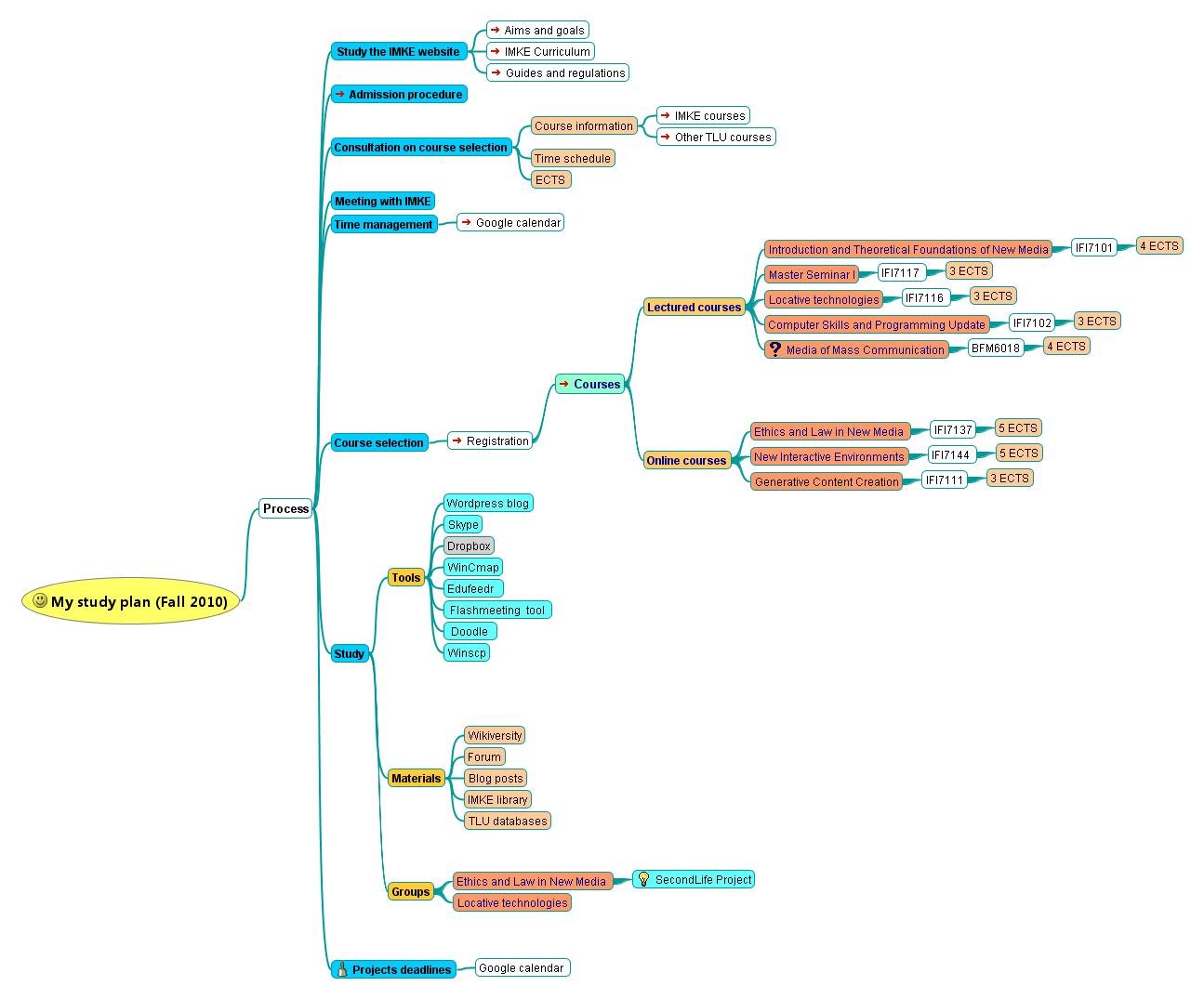
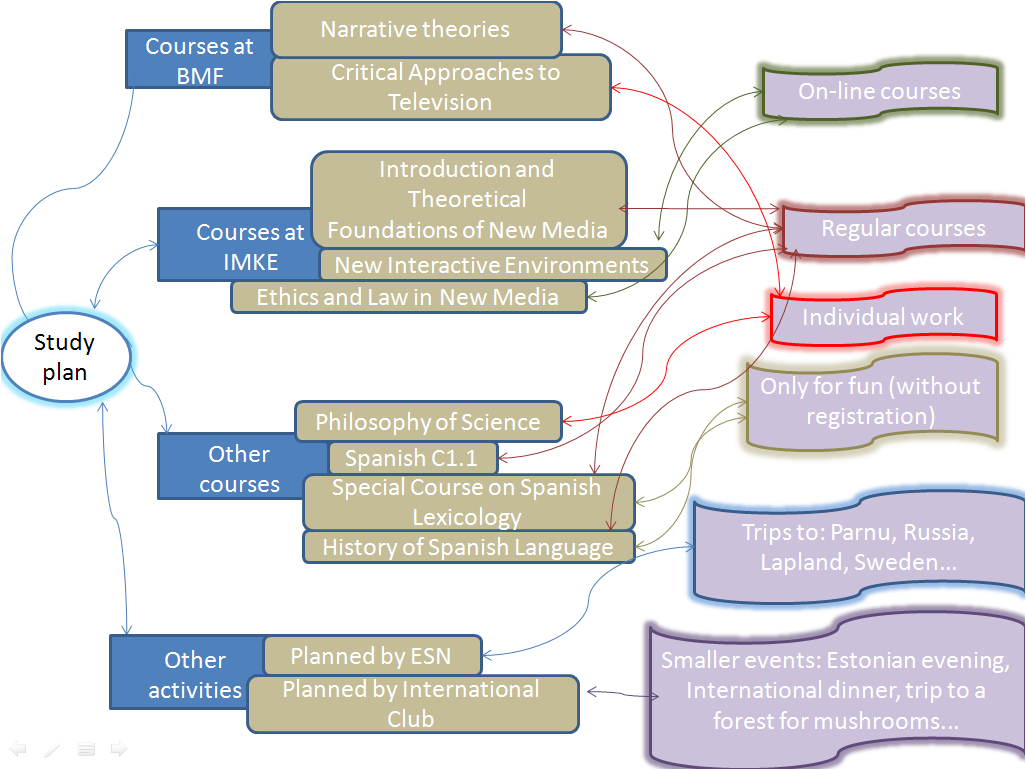
Rasa's study plan is a bit more complex including lectures from BMF, IMKE and language institutes. Being an exchange student, she is also involved in other activities organized by ESN and International Club. Kerstin and Mehrnoosh also mentioned the tools they have had to become acquainted with, such as Blogger/WordPress, CmapTools, Dropbox, etc. Mehrnoosh's mind map has a deeper level of detail - her activity starts with studying the IMKE website and admission procedure, without which she wouldn't have created the study plan. Clever! She has also listed our interactive study materials, such as Wikiversity, weblogs, forums, etc, and the groups we have had to form to carry out homework. One thing that was missing in all other concept maps, but is a very important component in creating a study plan, were the course credits (ECTS). Minimum 22.5 per semester, 120 altogether. Mehrnoosh didn't forget them. Well done!

I must say, although this task seemed a bit questionable to me at first, I found it very interesting and useful exploring the train of thought of my fellow students. I got to know what they consider important in their lives, decision making and time management, and what they are involved in after school, unless I already knew :) I also wised up about the web-based task and time management application Remember the Milk that Kerstin is using. I might check it out. Thanks!

Sunday, October 10, 2010

Task 2: Self-observation and analysis of creating a study plan

New Interactive Environments

The process sequencing, interactions and instruments of finding suitable courses for this semester, making decisions about the courses and scheduling them with other activities in life. For me the most important question was how to divide time between full-time work and full-time studies, and have some of it left for myself (to rest). Therefore, half of the subjects I chose are online courses or courses scheduled at weekends.

I used Glogster to visualize and map the structure of this activity. Some of the fun elements were added to experiment with this new tool I discovered a few weeks ago.

Thursday, September 30, 2010

Task 1: My experiences with Webpublishing

New Interactive Environments

My first experience with Webpublishing dates back to high school when I built a personal website using basic HTML as part of the Computer Science class. As this was also the time when I strarted travelling abroad, my personal homepage included flashbacks and photos of (school) trips. Photos, of course, were scanned and then uploaded, digital camera became part of my life several years later.

I created my first weblog for the same reason, i.e. travelling, when I set off for a year in Australia after my bachelor studies in 2006. Blog was the best way to keep in contact with my family and friends back home and those around the world, as time difference and limited Internet access made it difficult to call or chat online. The blogs we regularly updated with my close friend and travel companion blaze the trail to a real publishing experience. Our travel book 'Austraalia - Down Under' was published in September 2008, in collaboration with Pegasus. If it hadn't been for the blogs we frequently updated with a great passion and will, writing a book would have been difficult.

As for my current jobs, I'm employed part-time at two companies where I'm responsible for the content of two websites. One of them is a travel portal Turism.ee and the other one includes information on advertising in different publications of AS Eesti Ajalehed.

As many of you, I'm actively involved in social networks (mostly Facebook and travel communities). I follow RSS feeds through Feedreader, use communication tools (mainly Skype and MSN), Google Docs and Google Desktop. I'm interested in photography and recently bought a digital SLR camera, but haven't really used any photo publishing applications (apart from my personal blog and Facebook albums) as yet.

However, the breakthrough in my Webpublishing experience seems to be taking place now. Within the first 3 weeks at IMKE (Interactive Media and Knowledge Environments), I have created another personal blog for study purposes, set up Dropbox on my computer, downloaded and used IHMC CmapTools software, held weekly Skype conversations, used Flashmeeting tool for a videoconference, registered to a course on IVA, browsed social bookmarks on delicious.com, subscribed to Scribd, peeked into the 3D virtual world of Second Life, etc. I'm new to many of these tools and services, but I'm getting there!

-----

Terje's overview of our group's Webpublishing experience can be found on NIE's weblog.