Last week I heard about the One Laptop per Child (OLPC) program which aims "to create educational opportunities for the world's poorest children by providing each child with a rugged, low-cost, low-power, connected laptop with content and software designed for collaborative, joyful, self-empowered learning." Unless you already know about it, here's a short overview of the non-profit project led by Nicholas Negroponte, a Greek-American architect.
The OLPC laptops, known as the "$100 Laptop" or "Children's Machine", are sold to governments, to be distributed through the ministries of education with the goal of distributing "one laptop per child". The laptops are given to students, similar to school uniforms, and ultimately remain the property of the child. The operating system and software is localized to the languages of the participating countries.
When the laptop started mass production in November 2007, the unit price was estimated to be $188 when bought by thousand units. At the same time, the laptop was made available under the "Give 1 Get 1" program at $199 for a single unit, or $399 for 2 units.
In October 2007, Uruguay placed an order for 100,000 laptops. Since then, 200,000 more laptops have been ordered to cover all public school children between 6 and 12 years old. The country reportedly became the first in the world where every primary school child received a free laptop on 13 October 2009 as part of the Plan Ceibal (Education Connect). The South Pacific island nation of Niue also claimed this in August 2008. However, the total number of laptops ordered by now is the biggest in Peru (550,000 laptops, most recently ordered in March 2010).
Other participants in the project include for example Mexico, Haiti, Rwanda, Ghana, Afghanistan and Mongolia. A number of other countries are participting in pilot projects (from a few dozen to a few hundred laptops), including Mozambique, Madagascar, Nicaragua, Nepal, India, and many others.
Wednesday, October 13, 2010
Tuesday, October 12, 2010
Task 3: Comparison of descriptions of creating a study plan
New Interactive Environments
Take the descriptions of (at least) 5 other participants and look for similarities and differences.
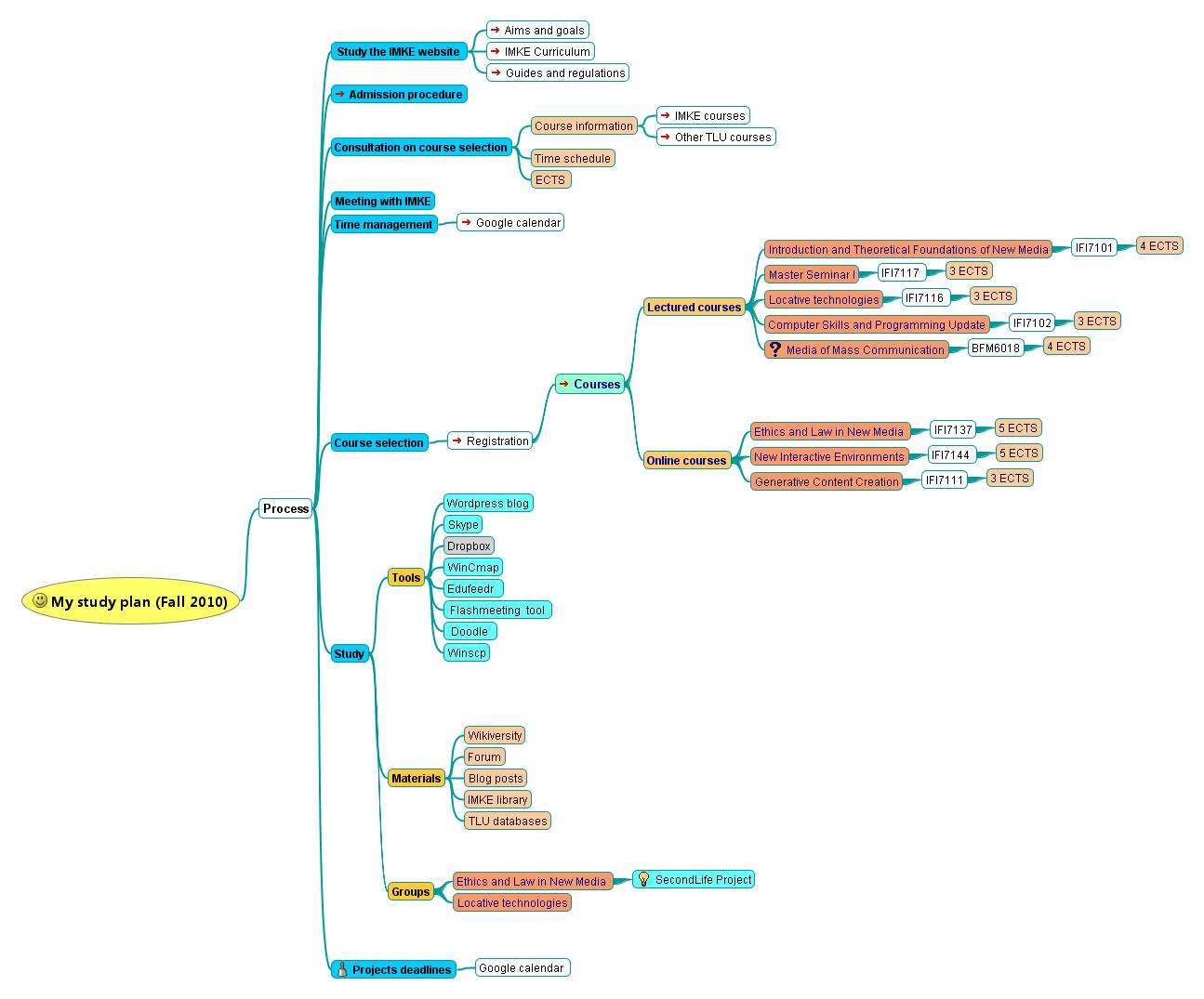
To start with, I noticed that most of my coursemates (at least the ones I looked into) have used concept maps to describe their activity of creating a study plan. We have been introduced to this graphical tool at another course and it seems to be received with open arms. Concept maps are both easy to read and to draw, saving us from pages of written text.
So, what are the similarities and differences I was able to perceive in those boxes and circles, connected with labeled arrows and linking phrases, such as "includes", "consists of", "results in", "contributes to", etc? The process of creating a study plan can't obviously vary too much in detail as most of us are in a similar situation of combining work and study and we are all IMKE students (same courses, same tasks, same tools). Even the same timetable, squeezed into a Google Calendar that we have all found very useful.
All the above mentioned maps show the differentiation of curriculum into general subjects, major subjects and free electives. However, Kristo was the only one to point out that he is also preparing for Master Thesis, while the others included it as one of the courses with the same objective: Master Seminar I. As both general and major subjects include compulsory and elective courses, the primary focus fell on the first ones, while electives were chosen based on personal interest (or, as Kersti names it, emotional factors). Makes sense, doesn't it? Other main factors considered were personal time and work load. For most of us, subjects that are not obligatory or take place in the middle of work day, were excluded from the study plan at an early stage. The free electives were mostly left for a backup plan to have more flexibility later in the studies. To make decisions, course programs (descriptions) were consulted. One thing we all seem to have forgotten is the human factor, did anyone else influence our decision making (fellow students, 2nd year students, lecturers, friends, family)?
Rasa's study plan is a bit more complex including lectures from BMF, IMKE and language institutes. Being an exchange student, she is also involved in other activities organized by ESN and International Club. Kerstin and Mehrnoosh also mentioned the tools they have had to become acquainted with, such as Blogger/WordPress, CmapTools, Dropbox, etc. Mehrnoosh's mind map has a deeper level of detail - her activity starts with studying the IMKE website and admission procedure, without which she wouldn't have created the study plan. Clever! She has also listed our interactive study materials, such as Wikiversity, weblogs, forums, etc, and the groups we have had to form to carry out homework. One thing that was missing in all other concept maps, but is a very important component in creating a study plan, were the course credits (ECTS). Minimum 22.5 per semester, 120 altogether. Mehrnoosh didn't forget them. Well done!
I must say, although this task seemed a bit questionable to me at first, I found it very interesting and useful exploring the train of thought of my fellow students. I got to know what they consider important in their lives, decision making and time management, and what they are involved in after school, unless I already knew :) I also wised up about the web-based task and time management application Remember the Milk that Kerstin is using. I might check it out. Thanks!
Take the descriptions of (at least) 5 other participants and look for similarities and differences.
- What elements, components, etc have been used by others to describe their activity?
- What level of detail?
- What structural aspects are showing up in their descriptions/visualizations?
- What is missing?
- What are pros and cons of the different approaches?
To start with, I noticed that most of my coursemates (at least the ones I looked into) have used concept maps to describe their activity of creating a study plan. We have been introduced to this graphical tool at another course and it seems to be received with open arms. Concept maps are both easy to read and to draw, saving us from pages of written text.
So, what are the similarities and differences I was able to perceive in those boxes and circles, connected with labeled arrows and linking phrases, such as "includes", "consists of", "results in", "contributes to", etc? The process of creating a study plan can't obviously vary too much in detail as most of us are in a similar situation of combining work and study and we are all IMKE students (same courses, same tasks, same tools). Even the same timetable, squeezed into a Google Calendar that we have all found very useful.
All the above mentioned maps show the differentiation of curriculum into general subjects, major subjects and free electives. However, Kristo was the only one to point out that he is also preparing for Master Thesis, while the others included it as one of the courses with the same objective: Master Seminar I. As both general and major subjects include compulsory and elective courses, the primary focus fell on the first ones, while electives were chosen based on personal interest (or, as Kersti names it, emotional factors). Makes sense, doesn't it? Other main factors considered were personal time and work load. For most of us, subjects that are not obligatory or take place in the middle of work day, were excluded from the study plan at an early stage. The free electives were mostly left for a backup plan to have more flexibility later in the studies. To make decisions, course programs (descriptions) were consulted. One thing we all seem to have forgotten is the human factor, did anyone else influence our decision making (fellow students, 2nd year students, lecturers, friends, family)?
Rasa's study plan is a bit more complex including lectures from BMF, IMKE and language institutes. Being an exchange student, she is also involved in other activities organized by ESN and International Club. Kerstin and Mehrnoosh also mentioned the tools they have had to become acquainted with, such as Blogger/WordPress, CmapTools, Dropbox, etc. Mehrnoosh's mind map has a deeper level of detail - her activity starts with studying the IMKE website and admission procedure, without which she wouldn't have created the study plan. Clever! She has also listed our interactive study materials, such as Wikiversity, weblogs, forums, etc, and the groups we have had to form to carry out homework. One thing that was missing in all other concept maps, but is a very important component in creating a study plan, were the course credits (ECTS). Minimum 22.5 per semester, 120 altogether. Mehrnoosh didn't forget them. Well done!
I must say, although this task seemed a bit questionable to me at first, I found it very interesting and useful exploring the train of thought of my fellow students. I got to know what they consider important in their lives, decision making and time management, and what they are involved in after school, unless I already knew :) I also wised up about the web-based task and time management application Remember the Milk that Kerstin is using. I might check it out. Thanks!
Sunday, October 10, 2010
Task 2: Self-observation and analysis of creating a study plan
New Interactive Environments
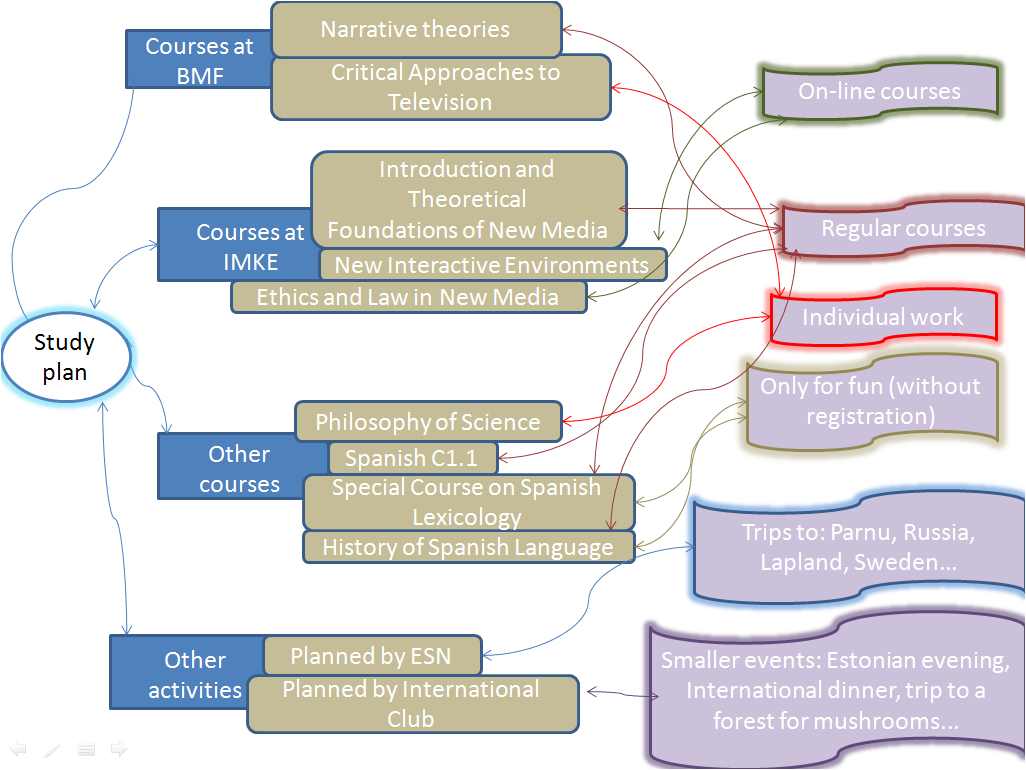
The process sequencing, interactions and instruments of finding suitable courses for this semester, making decisions about the courses and scheduling them with other activities in life. For me the most important question was how to divide time between full-time work and full-time studies, and have some of it left for myself (to rest). Therefore, half of the subjects I chose are online courses or courses scheduled at weekends.
I used Glogster to visualize and map the structure of this activity. Some of the fun elements were added to experiment with this new tool I discovered a few weeks ago.
The process sequencing, interactions and instruments of finding suitable courses for this semester, making decisions about the courses and scheduling them with other activities in life. For me the most important question was how to divide time between full-time work and full-time studies, and have some of it left for myself (to rest). Therefore, half of the subjects I chose are online courses or courses scheduled at weekends.
I used Glogster to visualize and map the structure of this activity. Some of the fun elements were added to experiment with this new tool I discovered a few weeks ago.
Friday, October 8, 2010
Week 4: Ethics and Law in New Media
October 4-10
Topic 7: The Digital Divide
Investigate and describe an illustrative case of digital divide in your country. Analyse and describe Internet availability. How big is the availability difference for urban and rural regions? Do you consider this a problem?
Estonia has one of the highest Internet penetration rates in the world. In the first quarter of 2010, 75% out of 1.34 mln people in the country used Internet according to Statistics Estonia (compared to 28% in 2000, a decade ago). Only 2% of the million Internet users use dial-up connections. 97% of businesses use computers on a daily basis, and 99% of these use Internet.
Computerization and digital connection for people are encouraged and supported by the state. A program named KülaTee3 (VillageWay3) was implemented from 2005-2008 to bring the opportunity of broadband Internet connectivity to the rural areas of Estonia. The primary goal of the program was to ensure broadband Internet connectivity for 90% of Estonia. Today, an estimated share of 98% of Estonia has been covered with the help of this program. Still, it must be taken into account that households located in valleys or surrounded by forest may need additional equipment for achieving connection (for example, putting up an antenna on the roof).
However, the statistics shows that the percentage of households who have Internet access at home is lower than the EU's average (65%): 63% of Estonian households have Internet at home, compared to 78% in Finland, 79% in Germany, 86% in Sweden, 90% in Netherlands (Eurostat). Is it people's own choice to not establish permanent Internet connection at home? Perhaps it is. Just about every Estonian has access to the Internet if and when they want it. Internet is available in all schools and libraries. Of Estonia's 45,000 square kilometres, there are more than 1,140 publicly registered wireless Internet points, most of which are available without cost. It is difficult to find a café or restaurant without free, wireless Internet, and the majority of local governments are also covered by wireless. Even under the most extreme circumstances it is only a few hundred metres to the nearest signal.
The way a modern society exercises its right to free Internet in daily life can be admired in Estonia. Some digital divide will always remain between different generations, just as some people may choose not to use Internet on a daily basis or not to use it at home after a whole day of sitting at the computer in the office, like they may choose to live in the countryside rather than hectic (capital) cities. To reduce the digital gap and bring an active e-life to those who, because of their age or other reasons, might have otherwise remained behind, a program named Vaata Maailma ("Look at the World") continues to offer free computer and internet training courses throughout Estonia. Thanks to the Vaata Maailma program, IT-savvy pensioners are not a rare sight in Estonia. Many actively handle their affairs via the Internet.
Similarly, to reduce the generation gap between parents and children, eKool helps parents stay involved in student education goals, and keeps them informed through the 24/7 web access to student information. Parents can communicate with teachers, have access to homework assignments and grade reports, see notes and communicate with teachers, get information about field trips and other school events. (The photo above portrays an example of the digital gap between generations, probably still quite common also in Estonia.)
Under this light, I don't consider the digital divide or the Internet availability a real problem in Estonia. It can always be better and Estonia is surely working on the progress. To overcome the digital gap between urban and rural areas, the common communications network must be taken to a new quality level enabling large volumes of data to be transmitted to all consumers in Estonia, not only to the nearly 70% of the population who lives in cities. Therefore, the state-funded development project EstWin is to build a new generation broadband network which would reach every Estonian resident by the year 2015 with connection speeds up to 100Mbit/s.
According to The Global Information Technology Report 2009-2010 (that highlights the key role of ICT as an enabler of a more economically, environmentally and socially sustainable world), Estonia ranks 25th in the Networked Readiness Index and is the highest ranking Central & Eastern European country.
Topic 8: Ubiquitous Computing
Compare the current situation in Estonia to the four scenarios of "Estonia 2010". Which one is the closest to the reality? How important do you deem the social cohesiveness (or caring) in reaching ubicomp?
The four possible scenarios proposed in 1995 to predict and analyse future trends were:
During the last 20 years, Estonia has developed a well functioning and secure e-state (Estonia is the only nation in the world which has survived a full-on cyberattack, emerging unscathed by mounting a vigorous self-defence). For citizens of Estonia, e-services have become routine: e-banking, e-taxes, e-elections, e-healthcare, e-school, to be named some. Most Estonians would not even consider doing things the oldfashioned way by physically visiting an office. Their time may be devoted to other pursuits. Many solutions engineered in Estonia have been later exported, including e-elections, e-school, and m-parking. Estonia is exporting its e-government technology and expertise across the globe, currently preparing new projects for the Palestinian territories, Afghanistan and Haiti. The e-Governance Academy has trained over 600 participants from 36 countries. This shows sufficient grounds for Estonia's innovative and educational potential.
Many important and fundamental innovations in e-Estonia have already been accomplished, but easing up after establishing momentum is out of the question. Significant projects continue, including EstWin. Also in the works is the full application of our digital healthcare system. And there is the daily work of keeping the existing system of e-services up-to-date, simplifying it, and making it increasingly user-friendly. This coming week, from October 13-15, E-Health Tallinn 2010 conference is held at Swissotel to provide an overview of problems and successes related to the implementation of the Estonian National Health Information System. Estonia is also to host a new European Union IT agency, after a deal with France which was the only other nation in the race. The headquarters of the EU's future IT agency will be located in Tallinn and it is expected to become operational in 2012.
Four new (or revised) scenarios have been proposed for Estonia 2018: "South Finland", "Hanseatic League II", "Skype Island" and "Return of the State". You can listen to the descriptions of these scenarios on Estonian Development Fund's videocasts webpage (in Estonian). The vision for 2018 in brief would be globally competitive and locally attractive Estonia.
Social cohesiveness (or caring)
Pekka Himanen, a Finnish philosopher and a public intellectual, suggests a model for meeting the challenges to the global development of the information society. It's a model of the information society combined with the welfare state where caring (or the social cohesiveness) plays a fundamental role. It can also be called fairness or the inclusion of all. Caring means that we work to create equal opportunities for all. This is the key idea of the welfare state. In the global development, it means that we protect the equal opportunities of all the people in the world. In Estonia, every citizen is encouraged to offer proposals for new e-services or present questions via the e-participation portal, osale.ee. Thanks to this process, the state's actions serve the actual needs of the citizens.
Caring for people's needs is an important factor in reaching ubicomp. The value of any IT solution is greater the more useful it is in everyday life, e-services are only useful if the citizenry is aware of them. On the other hand, caring helps to prevent the negative consequences of overcompetitive scenarios. In Estonia's case, it means the necessity to build network society rather than the society of brilliant and innovative businessmen. According to Manuel Castells, power now rests in networks: "the logic of the network is more powerful than the powers of the network". It is something Estonians have still got to learn - to care for each other, socialize and share their knowledge and information rather than everyone pushing forward on their own career- and success-driven path. Because too often the success lies in good communication and co-operation. Quoting another wise futurist author, Robert Theobald: "In the future, the development of our own personal styles and skills will be central. We shall come to understand that satisfaction, and effectiveness, develop as we learn to play and work with others. The compassionate era will be defined in terms of relationships rather than individualism." The individualism can, however, be understood in a country that has been repressed for so long and has finally gained the long-awaited independence. The society will eventually mature.
Topic 7: The Digital Divide
Investigate and describe an illustrative case of digital divide in your country. Analyse and describe Internet availability. How big is the availability difference for urban and rural regions? Do you consider this a problem?
Estonia has one of the highest Internet penetration rates in the world. In the first quarter of 2010, 75% out of 1.34 mln people in the country used Internet according to Statistics Estonia (compared to 28% in 2000, a decade ago). Only 2% of the million Internet users use dial-up connections. 97% of businesses use computers on a daily basis, and 99% of these use Internet.
Computerization and digital connection for people are encouraged and supported by the state. A program named KülaTee3 (VillageWay3) was implemented from 2005-2008 to bring the opportunity of broadband Internet connectivity to the rural areas of Estonia. The primary goal of the program was to ensure broadband Internet connectivity for 90% of Estonia. Today, an estimated share of 98% of Estonia has been covered with the help of this program. Still, it must be taken into account that households located in valleys or surrounded by forest may need additional equipment for achieving connection (for example, putting up an antenna on the roof).
However, the statistics shows that the percentage of households who have Internet access at home is lower than the EU's average (65%): 63% of Estonian households have Internet at home, compared to 78% in Finland, 79% in Germany, 86% in Sweden, 90% in Netherlands (Eurostat). Is it people's own choice to not establish permanent Internet connection at home? Perhaps it is. Just about every Estonian has access to the Internet if and when they want it. Internet is available in all schools and libraries. Of Estonia's 45,000 square kilometres, there are more than 1,140 publicly registered wireless Internet points, most of which are available without cost. It is difficult to find a café or restaurant without free, wireless Internet, and the majority of local governments are also covered by wireless. Even under the most extreme circumstances it is only a few hundred metres to the nearest signal.
The way a modern society exercises its right to free Internet in daily life can be admired in Estonia. Some digital divide will always remain between different generations, just as some people may choose not to use Internet on a daily basis or not to use it at home after a whole day of sitting at the computer in the office, like they may choose to live in the countryside rather than hectic (capital) cities. To reduce the digital gap and bring an active e-life to those who, because of their age or other reasons, might have otherwise remained behind, a program named Vaata Maailma ("Look at the World") continues to offer free computer and internet training courses throughout Estonia. Thanks to the Vaata Maailma program, IT-savvy pensioners are not a rare sight in Estonia. Many actively handle their affairs via the Internet.
Similarly, to reduce the generation gap between parents and children, eKool helps parents stay involved in student education goals, and keeps them informed through the 24/7 web access to student information. Parents can communicate with teachers, have access to homework assignments and grade reports, see notes and communicate with teachers, get information about field trips and other school events. (The photo above portrays an example of the digital gap between generations, probably still quite common also in Estonia.)
Under this light, I don't consider the digital divide or the Internet availability a real problem in Estonia. It can always be better and Estonia is surely working on the progress. To overcome the digital gap between urban and rural areas, the common communications network must be taken to a new quality level enabling large volumes of data to be transmitted to all consumers in Estonia, not only to the nearly 70% of the population who lives in cities. Therefore, the state-funded development project EstWin is to build a new generation broadband network which would reach every Estonian resident by the year 2015 with connection speeds up to 100Mbit/s.
According to The Global Information Technology Report 2009-2010 (that highlights the key role of ICT as an enabler of a more economically, environmentally and socially sustainable world), Estonia ranks 25th in the Networked Readiness Index and is the highest ranking Central & Eastern European country.
Topic 8: Ubiquitous Computing
Compare the current situation in Estonia to the four scenarios of "Estonia 2010". Which one is the closest to the reality? How important do you deem the social cohesiveness (or caring) in reaching ubicomp?
The four possible scenarios proposed in 1995 to predict and analyse future trends were:
- "Militaristic information oasis" - "little angry country" (like the one in Middle East) with good technological progress but little openness and overall freedom. "Military Estonia".
- "South Finland" - soft-spoken, well integrated into Europe (and decisively distanced from Russia), but with low innovation capacity. "Subcontractor Estonia" - perhaps the closest to current reality.
- "The Ferryman" - well-developed, but fully transit-based economy. Innovation and ICT are only to serve the main goal and thus of inferior importance. "Merchant Estonia", which is quite alike to the 'Singapore' scenario of Himanen seen in a previous lecture.
- "Grand Slam" - the best realisation of both geographical location (transit) and innovative and educational potential. "Innovation/ICT Estonia".
During the last 20 years, Estonia has developed a well functioning and secure e-state (Estonia is the only nation in the world which has survived a full-on cyberattack, emerging unscathed by mounting a vigorous self-defence). For citizens of Estonia, e-services have become routine: e-banking, e-taxes, e-elections, e-healthcare, e-school, to be named some. Most Estonians would not even consider doing things the oldfashioned way by physically visiting an office. Their time may be devoted to other pursuits. Many solutions engineered in Estonia have been later exported, including e-elections, e-school, and m-parking. Estonia is exporting its e-government technology and expertise across the globe, currently preparing new projects for the Palestinian territories, Afghanistan and Haiti. The e-Governance Academy has trained over 600 participants from 36 countries. This shows sufficient grounds for Estonia's innovative and educational potential.
Many important and fundamental innovations in e-Estonia have already been accomplished, but easing up after establishing momentum is out of the question. Significant projects continue, including EstWin. Also in the works is the full application of our digital healthcare system. And there is the daily work of keeping the existing system of e-services up-to-date, simplifying it, and making it increasingly user-friendly. This coming week, from October 13-15, E-Health Tallinn 2010 conference is held at Swissotel to provide an overview of problems and successes related to the implementation of the Estonian National Health Information System. Estonia is also to host a new European Union IT agency, after a deal with France which was the only other nation in the race. The headquarters of the EU's future IT agency will be located in Tallinn and it is expected to become operational in 2012.
Four new (or revised) scenarios have been proposed for Estonia 2018: "South Finland", "Hanseatic League II", "Skype Island" and "Return of the State". You can listen to the descriptions of these scenarios on Estonian Development Fund's videocasts webpage (in Estonian). The vision for 2018 in brief would be globally competitive and locally attractive Estonia.
Social cohesiveness (or caring)
Pekka Himanen, a Finnish philosopher and a public intellectual, suggests a model for meeting the challenges to the global development of the information society. It's a model of the information society combined with the welfare state where caring (or the social cohesiveness) plays a fundamental role. It can also be called fairness or the inclusion of all. Caring means that we work to create equal opportunities for all. This is the key idea of the welfare state. In the global development, it means that we protect the equal opportunities of all the people in the world. In Estonia, every citizen is encouraged to offer proposals for new e-services or present questions via the e-participation portal, osale.ee. Thanks to this process, the state's actions serve the actual needs of the citizens.
Caring for people's needs is an important factor in reaching ubicomp. The value of any IT solution is greater the more useful it is in everyday life, e-services are only useful if the citizenry is aware of them. On the other hand, caring helps to prevent the negative consequences of overcompetitive scenarios. In Estonia's case, it means the necessity to build network society rather than the society of brilliant and innovative businessmen. According to Manuel Castells, power now rests in networks: "the logic of the network is more powerful than the powers of the network". It is something Estonians have still got to learn - to care for each other, socialize and share their knowledge and information rather than everyone pushing forward on their own career- and success-driven path. Because too often the success lies in good communication and co-operation. Quoting another wise futurist author, Robert Theobald: "In the future, the development of our own personal styles and skills will be central. We shall come to understand that satisfaction, and effectiveness, develop as we learn to play and work with others. The compassionate era will be defined in terms of relationships rather than individualism." The individualism can, however, be understood in a country that has been repressed for so long and has finally gained the long-awaited independence. The society will eventually mature.
John Lennon Google Doodle
Google is celebrating John Lennon on his 70th birthday with a Google logo that plays one of Lennon's most loved songs "Imagine". Wonder how many views is a YouTube video advertised by the most visited page in the world able to get!?
Monday, October 4, 2010
iHelp for Autism
SF Weekly, the free alternative weekly newspaper in San Francisco, California, recently published an article about 9-year old Leo Rosa, a boy with intense autism, and his positive encounter with an iPad. "With the iPad, Leo electrifies the air around him with independence and daily new skills," said his mother Shannon.
Since the iPad's unveiling in April, autism experts and parents have brought it into countless homes and classrooms around the world. Developers have begun pumping out applications specifically designed for users with special needs, and initial studies are already measuring the effectiveness of the iPod Touch and the iPad as learning tools for children with autism. Through the devices, some of these children have been able to communicate their thoughts to adults for the first time. Others have learned life skills that had eluded them for years.
Though there are other computers designed for children with autism, a growing number of experts say that the iPad is better. It's cheaper, faster, more versatile, more user-friendly, more portable, more engaging, and infinitely cooler for young people.
Leo has plenty of toys, including this circular balance beam, but nothing tops the iPad.
View more photographs in the iHelp for Autism slideshow.
The article by Ashley Harrell can be found here.
Since the iPad's unveiling in April, autism experts and parents have brought it into countless homes and classrooms around the world. Developers have begun pumping out applications specifically designed for users with special needs, and initial studies are already measuring the effectiveness of the iPod Touch and the iPad as learning tools for children with autism. Through the devices, some of these children have been able to communicate their thoughts to adults for the first time. Others have learned life skills that had eluded them for years.
Though there are other computers designed for children with autism, a growing number of experts say that the iPad is better. It's cheaper, faster, more versatile, more user-friendly, more portable, more engaging, and infinitely cooler for young people.
Leo has plenty of toys, including this circular balance beam, but nothing tops the iPad.
View more photographs in the iHelp for Autism slideshow.
The article by Ashley Harrell can be found here.
Week 3: Ethics and Law in New Media
September 27 - October 3
Topic 5: The Big Brother on Menwith Hill
Read the "Inside Echelon" by Duncan Campbell. Write a blog opinion about the present situation of the system, what it is used for and how it can influence the global community. You can also draw a couple of hypothetical scenarios (what if).
Echelon - what it is (supposed to be) and what it is used for
Echelon was reportedly created to monitor the military and diplomatic communications of the Soviet Union and its Eastern Bloc allies during the Cold War in the early 1960s, but since the end of the Cold War it is believed to search also for hints of terrorist plots, drug dealers' plans, and political and diplomatic intelligence.
Intelligence monitoring of people has caused concern in the global community. Some critics claim the system is also being used for large-scale commercial theft, international economic espionage and invasion of privacy. Although routinely denied, commercial and economic intelligence is now a major target of international sigint activity - in short, to promote the economic well-being of countries like the US and the UK in relation to the actions or intentions of persons outside. An article in The Baltimore Sun reported in 1995 that European aerospace company Airbus lost a $6 billion contract with Saudi Arabia in 1994 after the US National Security Agency (NSA) reported that Airbus officials had been bribing Saudi officials to secure the contract.
Campbell reveals: "During the WWII as well as in the Cold War and since, British and US intelligence agencies monitored the signals and broke the codes of allies and friends, as well as of civilians and commercial communications around the world. The diplomatic communications of every country were and are attacked. In 1960, two NSA defectors, Bernon Mitchell and William Martin, told the world what NSA was doing: "Both enciphered and plain text communications are monitored from almost every nation in the world, including the nations on whose soil the intercept bases are located." These networks could carry anything from birthday telegrams to detailed economic or commercial information exchanged by companies, to encrypted diplomatic messages. Together with the leaders of African guerrilla movements, many prominent Americans were added to the 'watch lists'. The international communications of the actress Jane Fonda, Dr Benjamin Spock and hundreds of others were put under surveillance because of their opposition to the war in Vietnam. Black power leader Eldridge Cleaver and his colleagues were included because of their civil rights activities in the US.
How does Echelon operate?
The first component of the Echelon network are stations specifically targeted on the international telecommunications satellites (Intelsats) used by the telephone companies of most countries. The next component of the Echelon system intercepts a range of satellite communications not carried by Intelsat. A group of facilities that tap directly into land-based telecommunications systems is the final element of the Echelon system. Besides satellite and radio, the other main method of transmitting large quantities of public, business, and government communications is a combination of water cables under the oceans and microwave networks over land. Since most countries' microwave networks converge on the capital city, embassy buildings can be an ideal site. Protected by diplomatic privilege, they allow interception in the heart of the target country.
Any information sent via global communications satellites is pulled down by one of the main UKUSA spy stations around the world and automatically decoded by computer. The messages are put into bundles according to key words. Workers at GCSB (Government Communications Security Bureau) and its UKUSA partners type in a category and then are able to download a bundle of documents which they can read, translate from a foreign language or summarise. Reports prepared in one agency are available to others. The basic framework is set by the NSA and largely serves US spy interests.
A lesson to re-learn
In the information age, we need to re-learn a lesson now a century old. Despite the sophistication of 21st century technology, today's e-mails are as open to the eyes of snoopers and intruders as were the first crude radio telegraph messages.
In 2001 the Temporary Committee on the Echelon Interception System recommended to the European Parliament that citizens of member states routinely use cryptography in their communications to protect their privacy, because economic espionage with Echelon has been conducted by the US intelligence. Until such protections become effective and ubiquitous, Echelon or systems like it, will remain with us. Though the largest surveillance network is run by the US NSA, it is far from alone. Russia, China, France and other nations operate worldwide networks. Dozens of advanced nations use sigint as a key source of intelligence.
Let us have an intelligence agency, but let all its methods and results be public
Spying thrives on secrecy and this is nowhere more true than in the world of signals intelligence or sigint. This entire process is so secret that even most politicians know almost nothing about it. According to Brian Martin, sigint is remarkably useless. It is hard to point to a single "success", namely a benefit to society that would justify the expenditure on this sort of spying. "It seems that covertly sifting through vast volumes of electronic communications seldom provides any insight beyond what is available in publicly available sources. This suggests that the best way to develop real "intelligence" is through an open system. By all means let us have an "intelligence" agency, but let all its methods and results be public, open to scrutiny. This would be much more democratic. A regular process of scrutiny and debate would undoubtedly produce better insights into world affairs", he writes in his review of Secret Power by Nicky Hager.
Hager says, regarding the Echelon system, that "the secrecy surrounding it makes it so impervious to democratic oversight, that the temptation to use it for questionable projects seems irresistible" (p. 52). This is the crux of the matter. Highly secret spy operations are not appropriate in a democracy. Hager quotes a GCSB officer: "The secrecy is not for the Russians, it is for the general public. If they knew what the bureau does, it would not be allowed to continue." (p. 250).
Duncan Campbell names Secret Power by Nicky Hager the best informed and most detailed account of how Echelon works.
Free version of the full book can be downloaded here.
"An astonishing number of people have told him things that I, as Prime Minister in charge of the intelligence services, was never told. It is an outrage that I and other ministers were told so little." - David Lange, Prime Minister of New Zealand 1984-1989
Topic 6: Rid the Fools of Their Money: The Online World of Crime and Fraud
Write a blog description of an Internet fraud (scam) scheme. Review the scambaiting websites mentioned. Analyse them from an ethical point of view.
As pointed out in the lecture material, Fraud.org gives a good overview of the trends. The statistics have been updated and list the 2007 Top 10 Internet Scams. The highest % of complaints is now filed against Fake Check Scams, 29% (only 6% in 2005), and General Merchandise, 23%, average financial loss being $3,310.87 and $1,136.84 accordingly. The Nigerian Money Offers have also gained a bigger 'market share', 11%, fortunately with a notable decline in average loss from $6,937 in 2005 to $4,043.14 in 2007. Despite the drop, it is still the most expensive scam. At the bottom of the Top 10, two new scams can be found: Prizes/Sweepstakes and Friendship and Sweetheart Swindles. The saying "love hurts" is proving true for consumers who have searched for romance online, only to lose thousands of dollars to a supposed suitor. The average loss per victim is similarly high here, $3,038.31. However, the full extent of the fraud is unknown, given many victims' reluctance to admit to being scammed.
Love Stinks: The Scheme of the Scam
The Sweetheart Swindle is often a long, drawn out process in which the con artist nurtures a relationship, and eventually convinces the victim to send money repeatedly over an extended period of time. Scammers lurk in chat rooms and on online dating sites, attempting to earn someone's affections and trust so that they can persuade him or her to send money. What consumers using these dating websites fail to recognize, is that they may be working with professional con artists, many who may even be using stolen identities with which to fabricate information they're giving out.
Though the details of the scammers' stories vary with each individual case, the scenario commonly revolves around a tragedy having befallen the scammer, and he or she desperately needs money. After spending time communicating and building a relationship with the victim, the scammer asks for help in the form of money.
An Example Tale of 'Love' Gone Wrong: Victim Sweethearts
In April 2007, Donna cautiously ventured into the world of online dating. Within a week, she was contacted by a man with whom she began to chat. They chatted multiple times a day for seven months. He said he was a wealthy business man, who lived in a nearby city and was temporarily in Africa on business. In October, he said his contract in Africa would soon be up and that he wanted to meet, but he needed $250 to hold him over until a check cleared. Donna offended her new sweetie when she expressed her hesitancy to give money to a stranger. So she sent him the money, and later another $1,500, never to hear from him again.
Note: Another such scam is when a woman contacts several, sometimes many, men, usually older and lonely. First she starts up a email relationship. Then within a week or two, it gets heated, then she hits the mark. She wants to visit him in person. She has sent him her picture, usually a picture of a model taken from an online website. He is smitten. She asks either for money to buy a 'first class' airline ticket, or asks him to buy the ticket, which she can resell. She may do this to 10 or 20 men. A first class ticket, especially across country (U.S.), can run $1000 to $3000. Multiply that by 10 or 20 men, a sizable sum. He never hears from her again. She moves to another town or state, and starts all over again. The next time you hear a song "love hurts", you know.
Read more: News from Fraud.org
Social Engineering Supreme: Letting the Scammers Taste Their Own Medicine
Scambaiting's objective is to keep the scam going as long as possible, costing the scammer time and energy, and to gather as much information as possible to share with authorities. Amusement that the baiter may gain from the interaction include fooling the scammer into falling for claims just as ludicrous as the ones that the scammer is using to bilk the victim of money. It is, in essence, a form of social engineering that may have an altruistic motive or may be motivated by malice.
Having visited a few scambaiting websites, such as 419 Eater, theScamBaiter, Scam-O-Rama and WhatsTheBloodyPoint, my impression was rather dodgy from the start. Is it possible to fight the bad with bad, fraud with fraud? How do I know the roles won't change and I won't end up in a position of a victim? Although scambaiting tips can be found on all of the above mentioned websites and 419 Eater even invities newcomers to join their mentor program, it is strongly advised that you must not enter into any communications with scammers unless you feel you are adequately prepared to deal with them.
Scambaiting veterans call it a great cybersport, and invite you to have fun while doing a public service. Most decent people who stumble across these sites are initially amused by the antics but then start to feel some pangs of conscience. Scambaiters themselves have no problem with baiting. "Every scammer baited, every lad who poses with a sign for a baiter, every false form filled in, every fake bank taken down means that less victims are scammed. We keep the scammers busy with 'safe' targets. We occupy them and waste their time. Hopefully some will decide it's not worth it and get an honest job. Others may get caught in a sting," they say. Nontheless, this kind of vigilanteism remains reprehensible and legally questionable, just like the 'fun' part of it.
Don't try this at home. Though it may seem very tempting to reply to one of these scam letters to see just what happens, your best friend is the button on your computer that is marked "delete", use it often. This is a piece of advice given by Mike Potter, an experienced scam baiter from England.
Topic 5: The Big Brother on Menwith Hill
Read the "Inside Echelon" by Duncan Campbell. Write a blog opinion about the present situation of the system, what it is used for and how it can influence the global community. You can also draw a couple of hypothetical scenarios (what if).
Echelon - what it is (supposed to be) and what it is used for
Echelon was reportedly created to monitor the military and diplomatic communications of the Soviet Union and its Eastern Bloc allies during the Cold War in the early 1960s, but since the end of the Cold War it is believed to search also for hints of terrorist plots, drug dealers' plans, and political and diplomatic intelligence.Intelligence monitoring of people has caused concern in the global community. Some critics claim the system is also being used for large-scale commercial theft, international economic espionage and invasion of privacy. Although routinely denied, commercial and economic intelligence is now a major target of international sigint activity - in short, to promote the economic well-being of countries like the US and the UK in relation to the actions or intentions of persons outside. An article in The Baltimore Sun reported in 1995 that European aerospace company Airbus lost a $6 billion contract with Saudi Arabia in 1994 after the US National Security Agency (NSA) reported that Airbus officials had been bribing Saudi officials to secure the contract.
Campbell reveals: "During the WWII as well as in the Cold War and since, British and US intelligence agencies monitored the signals and broke the codes of allies and friends, as well as of civilians and commercial communications around the world. The diplomatic communications of every country were and are attacked. In 1960, two NSA defectors, Bernon Mitchell and William Martin, told the world what NSA was doing: "Both enciphered and plain text communications are monitored from almost every nation in the world, including the nations on whose soil the intercept bases are located." These networks could carry anything from birthday telegrams to detailed economic or commercial information exchanged by companies, to encrypted diplomatic messages. Together with the leaders of African guerrilla movements, many prominent Americans were added to the 'watch lists'. The international communications of the actress Jane Fonda, Dr Benjamin Spock and hundreds of others were put under surveillance because of their opposition to the war in Vietnam. Black power leader Eldridge Cleaver and his colleagues were included because of their civil rights activities in the US.
How does Echelon operate?
The first component of the Echelon network are stations specifically targeted on the international telecommunications satellites (Intelsats) used by the telephone companies of most countries. The next component of the Echelon system intercepts a range of satellite communications not carried by Intelsat. A group of facilities that tap directly into land-based telecommunications systems is the final element of the Echelon system. Besides satellite and radio, the other main method of transmitting large quantities of public, business, and government communications is a combination of water cables under the oceans and microwave networks over land. Since most countries' microwave networks converge on the capital city, embassy buildings can be an ideal site. Protected by diplomatic privilege, they allow interception in the heart of the target country.
Any information sent via global communications satellites is pulled down by one of the main UKUSA spy stations around the world and automatically decoded by computer. The messages are put into bundles according to key words. Workers at GCSB (Government Communications Security Bureau) and its UKUSA partners type in a category and then are able to download a bundle of documents which they can read, translate from a foreign language or summarise. Reports prepared in one agency are available to others. The basic framework is set by the NSA and largely serves US spy interests.A lesson to re-learn
In the information age, we need to re-learn a lesson now a century old. Despite the sophistication of 21st century technology, today's e-mails are as open to the eyes of snoopers and intruders as were the first crude radio telegraph messages.
In 2001 the Temporary Committee on the Echelon Interception System recommended to the European Parliament that citizens of member states routinely use cryptography in their communications to protect their privacy, because economic espionage with Echelon has been conducted by the US intelligence. Until such protections become effective and ubiquitous, Echelon or systems like it, will remain with us. Though the largest surveillance network is run by the US NSA, it is far from alone. Russia, China, France and other nations operate worldwide networks. Dozens of advanced nations use sigint as a key source of intelligence.
Let us have an intelligence agency, but let all its methods and results be public
Spying thrives on secrecy and this is nowhere more true than in the world of signals intelligence or sigint. This entire process is so secret that even most politicians know almost nothing about it. According to Brian Martin, sigint is remarkably useless. It is hard to point to a single "success", namely a benefit to society that would justify the expenditure on this sort of spying. "It seems that covertly sifting through vast volumes of electronic communications seldom provides any insight beyond what is available in publicly available sources. This suggests that the best way to develop real "intelligence" is through an open system. By all means let us have an "intelligence" agency, but let all its methods and results be public, open to scrutiny. This would be much more democratic. A regular process of scrutiny and debate would undoubtedly produce better insights into world affairs", he writes in his review of Secret Power by Nicky Hager.
Hager says, regarding the Echelon system, that "the secrecy surrounding it makes it so impervious to democratic oversight, that the temptation to use it for questionable projects seems irresistible" (p. 52). This is the crux of the matter. Highly secret spy operations are not appropriate in a democracy. Hager quotes a GCSB officer: "The secrecy is not for the Russians, it is for the general public. If they knew what the bureau does, it would not be allowed to continue." (p. 250).
Duncan Campbell names Secret Power by Nicky Hager the best informed and most detailed account of how Echelon works.Free version of the full book can be downloaded here.
"An astonishing number of people have told him things that I, as Prime Minister in charge of the intelligence services, was never told. It is an outrage that I and other ministers were told so little." - David Lange, Prime Minister of New Zealand 1984-1989
Topic 6: Rid the Fools of Their Money: The Online World of Crime and Fraud
Write a blog description of an Internet fraud (scam) scheme. Review the scambaiting websites mentioned. Analyse them from an ethical point of view.
As pointed out in the lecture material, Fraud.org gives a good overview of the trends. The statistics have been updated and list the 2007 Top 10 Internet Scams. The highest % of complaints is now filed against Fake Check Scams, 29% (only 6% in 2005), and General Merchandise, 23%, average financial loss being $3,310.87 and $1,136.84 accordingly. The Nigerian Money Offers have also gained a bigger 'market share', 11%, fortunately with a notable decline in average loss from $6,937 in 2005 to $4,043.14 in 2007. Despite the drop, it is still the most expensive scam. At the bottom of the Top 10, two new scams can be found: Prizes/Sweepstakes and Friendship and Sweetheart Swindles. The saying "love hurts" is proving true for consumers who have searched for romance online, only to lose thousands of dollars to a supposed suitor. The average loss per victim is similarly high here, $3,038.31. However, the full extent of the fraud is unknown, given many victims' reluctance to admit to being scammed.
Love Stinks: The Scheme of the Scam
The Sweetheart Swindle is often a long, drawn out process in which the con artist nurtures a relationship, and eventually convinces the victim to send money repeatedly over an extended period of time. Scammers lurk in chat rooms and on online dating sites, attempting to earn someone's affections and trust so that they can persuade him or her to send money. What consumers using these dating websites fail to recognize, is that they may be working with professional con artists, many who may even be using stolen identities with which to fabricate information they're giving out.
Though the details of the scammers' stories vary with each individual case, the scenario commonly revolves around a tragedy having befallen the scammer, and he or she desperately needs money. After spending time communicating and building a relationship with the victim, the scammer asks for help in the form of money.
An Example Tale of 'Love' Gone Wrong: Victim Sweethearts
In April 2007, Donna cautiously ventured into the world of online dating. Within a week, she was contacted by a man with whom she began to chat. They chatted multiple times a day for seven months. He said he was a wealthy business man, who lived in a nearby city and was temporarily in Africa on business. In October, he said his contract in Africa would soon be up and that he wanted to meet, but he needed $250 to hold him over until a check cleared. Donna offended her new sweetie when she expressed her hesitancy to give money to a stranger. So she sent him the money, and later another $1,500, never to hear from him again.
Note: Another such scam is when a woman contacts several, sometimes many, men, usually older and lonely. First she starts up a email relationship. Then within a week or two, it gets heated, then she hits the mark. She wants to visit him in person. She has sent him her picture, usually a picture of a model taken from an online website. He is smitten. She asks either for money to buy a 'first class' airline ticket, or asks him to buy the ticket, which she can resell. She may do this to 10 or 20 men. A first class ticket, especially across country (U.S.), can run $1000 to $3000. Multiply that by 10 or 20 men, a sizable sum. He never hears from her again. She moves to another town or state, and starts all over again. The next time you hear a song "love hurts", you know.
Read more: News from Fraud.org
Social Engineering Supreme: Letting the Scammers Taste Their Own Medicine
Scambaiting's objective is to keep the scam going as long as possible, costing the scammer time and energy, and to gather as much information as possible to share with authorities. Amusement that the baiter may gain from the interaction include fooling the scammer into falling for claims just as ludicrous as the ones that the scammer is using to bilk the victim of money. It is, in essence, a form of social engineering that may have an altruistic motive or may be motivated by malice.
Having visited a few scambaiting websites, such as 419 Eater, theScamBaiter, Scam-O-Rama and WhatsTheBloodyPoint, my impression was rather dodgy from the start. Is it possible to fight the bad with bad, fraud with fraud? How do I know the roles won't change and I won't end up in a position of a victim? Although scambaiting tips can be found on all of the above mentioned websites and 419 Eater even invities newcomers to join their mentor program, it is strongly advised that you must not enter into any communications with scammers unless you feel you are adequately prepared to deal with them.
Scambaiting veterans call it a great cybersport, and invite you to have fun while doing a public service. Most decent people who stumble across these sites are initially amused by the antics but then start to feel some pangs of conscience. Scambaiters themselves have no problem with baiting. "Every scammer baited, every lad who poses with a sign for a baiter, every false form filled in, every fake bank taken down means that less victims are scammed. We keep the scammers busy with 'safe' targets. We occupy them and waste their time. Hopefully some will decide it's not worth it and get an honest job. Others may get caught in a sting," they say. Nontheless, this kind of vigilanteism remains reprehensible and legally questionable, just like the 'fun' part of it.
Don't try this at home. Though it may seem very tempting to reply to one of these scam letters to see just what happens, your best friend is the button on your computer that is marked "delete", use it often. This is a piece of advice given by Mike Potter, an experienced scam baiter from England.
Subscribe to:
Posts (Atom)